
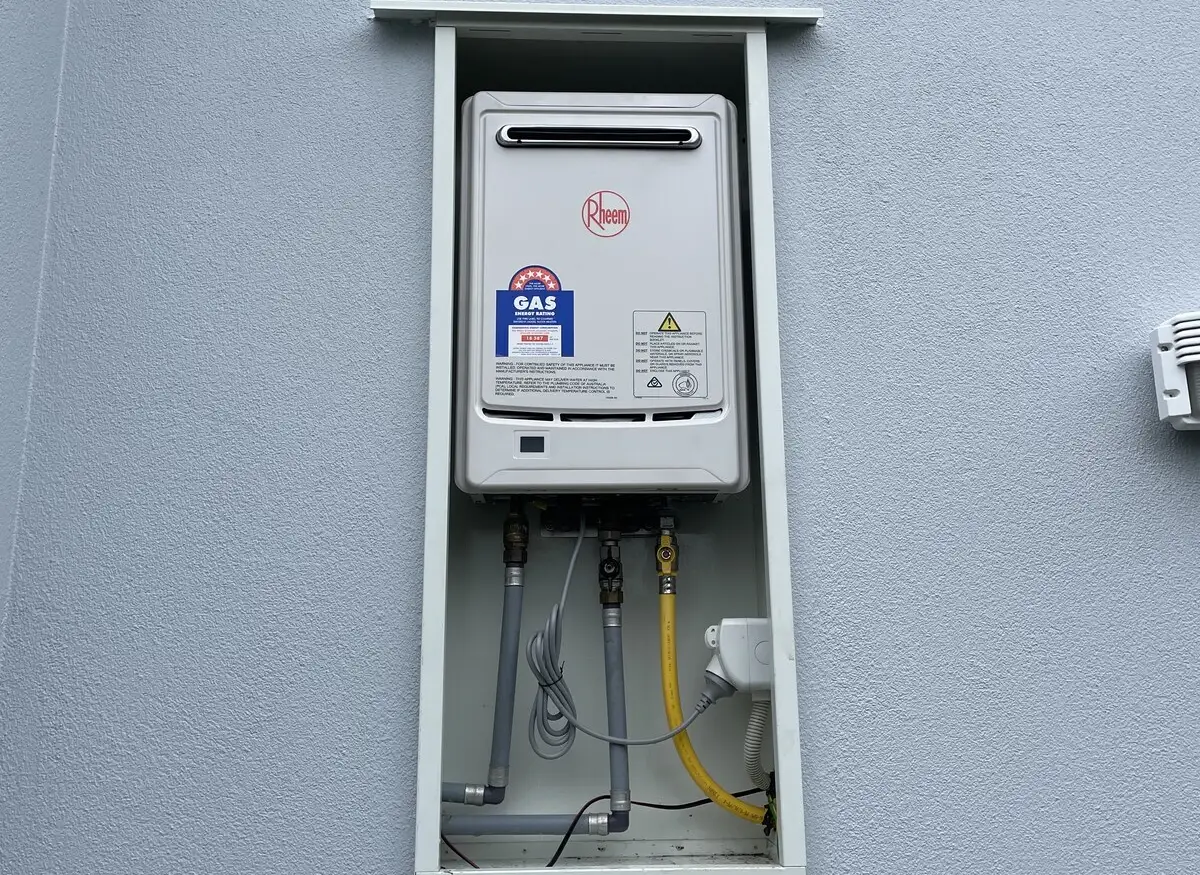
Gas used to be the cheaper way to heat water in Auckland. Price rises since 2024 have closed most of that gap, and a hot water heat pump now undercuts both fuels. Gas still earns its place in plenty of North Shore homes, for flow, space and houses that already cook on it.
This guide compares running costs using EECA’s figures, sets out what has changed for gas, and covers the practical points that decide it: flow, space, noise, power cuts and what switching involves.
Is gas hot water cheaper to run than electric?
Only against a standard electric cylinder, and barely. EECA’s modelling for a four-person household puts a gas califont within about 10% of an electric cylinder’s running cost, before the gas connection charge. A hot water heat pump costs under a third of either.
EECA modelled the three systems in 2023 with gas at 60% of the electricity price per kWh. Over 10 years, including installation, the heat pump came out 21% cheaper than gas continuous flow and 27% cheaper than an electric cylinder.
Prices have moved since, in both directions. Consumer NZ reports gas rising 17.5% and electricity 12.2% in 2025, then electricity 13.1% and gas 10.8% in 2026. Over the two years gas has risen a little faster, so the ranking holds, and Consumer expects gas to keep rising faster over the long term.
How do the systems compare?
The table uses EECA’s figures for a four-person household, with costs relative to a standard electric cylinder, because energy prices and plans vary by home.
| Electric cylinder | Hot water heat pump | Gas califont (continuous flow) | |
|---|---|---|---|
| Running cost | The baseline | Under a third of the baseline | About the baseline, plus a fixed gas charge |
| To install | The baseline | About two and a half times | About the baseline |
| CO2 | 3.5 times a heat pump | Lowest | About 6.5 times a heat pump |
| Hot water supply | Stored tank, reheats in hours | Stored tank, reheats slowest | Continuous, limited by flow rate |
| In a power cut | Tank stays hot for a while | Tank stays hot for a while | No hot water |
| Space | Cupboard or outside | Outside unit, or split with an indoor tank | Outside wall, no tank |
Gas storage cylinders aren’t in EECA’s model. Run on LPG bottles instead of piped gas, any gas system costs more again, with bottle rental on top. EECA calls LPG the most expensive option for fuel, and Consumer NZ advises against installing LPG water heating.
What has changed for gas hot water since 2024?
Supply is shrinking and fixed costs are rising. The Commerce Commission says New Zealand’s gas production “has halved since 2016”, and fewer Auckland homes are connecting to gas each year. Gas isn’t going away: the Commission expects it to “remain part of the energy system for years to come”.
Consumer NZ says “huge hikes in the price of natural gas” have made gas water heaters “less cost-effective”, and warns that one installed today “could be economically unviable before the end of its lifetime”. The detail matters if you’re choosing a system to last 15 years:
- Network charges. The Commission’s 2026 decision lifts most household gas bills by around 1 to 3% from 01/10/2026, before inflation. Auckland households face “slightly higher increases, phased in over time”, because Auckland’s pipeline charges were historically lower. Vector’s own distribution prices, one part of the bill, rose 12.7% on average on 01/10/2026. Pipeline costs are “largely fixed”, so fewer customers means each one pays more.
- Fewer connections. In the six months to 31/12/2025, Vector connected 341 new gas customers, down 50.9% on a year earlier, with a net loss of 317 customers. Consumer NZ quotes Vector’s forecast of “no new [household] connections from 2029 onwards”.
- New connections cost more. Since 01/05/2025, Vector has charged new gas customers the full cost of the pipework that serves only their property.
- Supply. Consumer NZ reports the Māui field is expected to stop producing by the end of 2026.
When does gas hot water still make sense?
When the house already runs on piped gas for cooking or a fire, the household needs several showers at once, or there’s no room for a tank. A califont delivers hot water continuously, mounts on an outside wall and frees the cupboard for storage.
The fixed charge decides more than most comparisons admit. If you keep a gas hob or fireplace, you pay the daily connection charge whatever heats your water, so the extra cost of gas hot water is only the gas it burns. If hot water is the only thing on gas, the whole charge belongs to it, and the case for a heat pump is at its strongest.
Flow is gas’s other strength, though “endless hot water” overstates it: in an Auckland winter a 26 litre califont delivers about 16 litres a minute. That never runs out, and it covers two showers at once.
Efficiency varies between gas units too, and EECA names condensing continuous flow the most efficient gas option. Rinnai’s condensing EF26 produces the same flow as the A26 on a maximum gas input of 175 MJ/h instead of 199, because a second heat exchanger captures heat that would otherwise go up the flue. For sizing, and the choice between a califont and a cylinder, see califont or hot water cylinder?
When is a heat pump the better choice?
When an electric cylinder or gas-only hot water system is due for replacement, there’s space outside, and the household uses enough hot water to repay the higher installation cost. EECA’s guidance is to consider a heat pump rather than a like-for-like swap whenever an ageing cylinder is replaced.
A hot water heat pump moves heat from the outside air into the water, giving 2 to 4 units of heat for each unit of electricity, according to EECA. A standard cylinder gets just under 1. Auckland’s mild winters help: EECA notes the same model achieves a higher efficiency here than in Christchurch.
Check these before you commit:
- Space and siting. An integrated unit, with the heat pump on top of the tank, must sit outside. A split system puts the fan unit outside and the tank inside, nearer the taps. A 265-litre integrated unit weighs about 385 kg full, according to Rinnai’s spec sheet, so it needs a solid base.
- Noise. EECA says heat pumps “can make more noise than other methods of hot water heating”. Rinnai rates its Enviroflo at 46 dB(A). On a tight North Shore section, keep it away from bedroom windows, including the neighbours’.
- Recovery. The same Enviroflo reheats about 60 litres an hour on the heat pump alone. A califont delivers that in under four minutes. The tank must cover your peak use, with the backup element covering the rest.
- Backup element. Outside the unit’s operating range, -5°C to 43°C for the Enviroflo, the electric element takes over. Rheem and Rinnai fit one as standard, and a unit left in electric or boost mode runs like an ordinary cylinder.
- Lifespan. EECA puts heat pumps at 8 to 15 years, similar to gas units and shorter than a plain cylinder, because they have more moving parts.
If the old system is a low pressure cylinder in a villa or bungalow, most replacements, heat pumps included, are mains pressure. That changes the pressure on old pipework, so ask about it at the quote.
Is a standard electric cylinder still worth fitting?
As a like-for-like replacement, yes, where there’s no room outside for a heat pump or the household uses too little hot water for one to pay back. It’s the simplest system, usually swapped in a few hours, and fits most cupboards. Running cost is the trade-off; rooftop solar, or heating on a controlled or night-rate supply, narrows it.
EECA puts a standard cylinder’s life at 10 to 15 years. If yours is near that age, our guide to how long hot water cylinders last covers the signs. Whatever you choose, stored water must reach 60°C to control Legionella, with a tempering valve limiting bathroom taps to 50°C; see the 60°C rule and tempering valves.
What does switching between gas and electric involve?
Gas to electric needs a gasfitter to disconnect and cap the gas supply, plus an electrician for the new circuit. Electric to gas needs a gas supply big enough for the califont, a flue position that meets the clearance rules and, on natural gas, possibly a new connection.
Gas to electric. If other appliances stay on gas, the meter stays and nothing changes with your retailer. If hot water was the last gas appliance, close the gas account, and ask about removing the meter: Consumer NZ reports a household still being charged the daily fee because the meter remained, with a fee to remove it.
Electric to gas. A califont is one of the largest gas appliances in a home; an A26 can draw up to 199 MJ/h at full output. The meter, regulator and pipework must carry that alongside the hob or fire, so the gasfitter sizes the supply before quoting. A califont also needs a power point outside and a flue position clear of windows and doors. Without piped gas at the street, LPG is the alternative, with its higher fuel cost.
Either way, gas work is restricted work. At HW Group it’s done and certified by our own licensed gasfitter, and you receive the certificate on completion.
What we do when you ask us about replacing your hot water
We start with what’s there: the system, its age, whether the house has piped gas or LPG, and what else runs on gas. Then we look at the space outside, the pipework and how many people use hot water at once.
If gas still suits the house, we recommend the gas unit and explain why. If a heat pump or electric cylinder suits it better, we tell you that instead. Either way you get the options and the price in writing before we start.
See our gas hot water page for califonts and gas cylinders.