
Ask ten plumbing websites how long a hot water cylinder lasts and you get ten answers, from 8 years to 40. None cites a source. The manufacturers publish something more useful: a tank warranty, the factors that shorten a cylinder’s life, and a service schedule most owners have never seen. This guide is built on those documents.
How long does a hot water cylinder last in New Zealand?
Consumer NZ estimates around 10 to 15 years, and plenty of cylinders run longer. No manufacturer publishes a lifespan. The firm number is the tank warranty, from five years on low pressure copper to twelve on a Rheem Optima. Whether yours beats it depends on the anode, your water and how the cylinder has been looked after.
Rheem’s owner guides list the factors: “the water quality, water pressure, water temperature and the usage pattern.” A serviced cylinder on a town supply routinely outlives its warranty. One that sits unused for months, or whose anode has run out unnoticed, can fail inside it.
Why do some cylinders last longer than others?
It comes down to what the tank is made of and what protects it. Enamel steel tanks rely on a sacrificial anode that corrodes first; once it is gone, the tank corrodes. Copper and stainless tanks have no anode and depend on your water chemistry. Gas and heat pump units add parts that wear on their own schedule.
| Cylinder type | What protects the tank | How it usually ends | Tank warranty |
|---|---|---|---|
| Low pressure copper (older homes, header tank in the roof) | The copper itself | Pitting from aggressive water or silt; scale on the element in hard water | 5 years (Rheem, Rinnai) |
| Mains pressure enamel (glass-lined steel) | A sacrificial anode | The anode is used up, then the tank rusts through | 10 years Rheem (7 if made before June 2018), 7 years Rinnai, 12 years Rheem Optima |
| Mains pressure stainless steel | The stainless steel | Pitting from particles or aggressive water | 10 years (Rheem) |
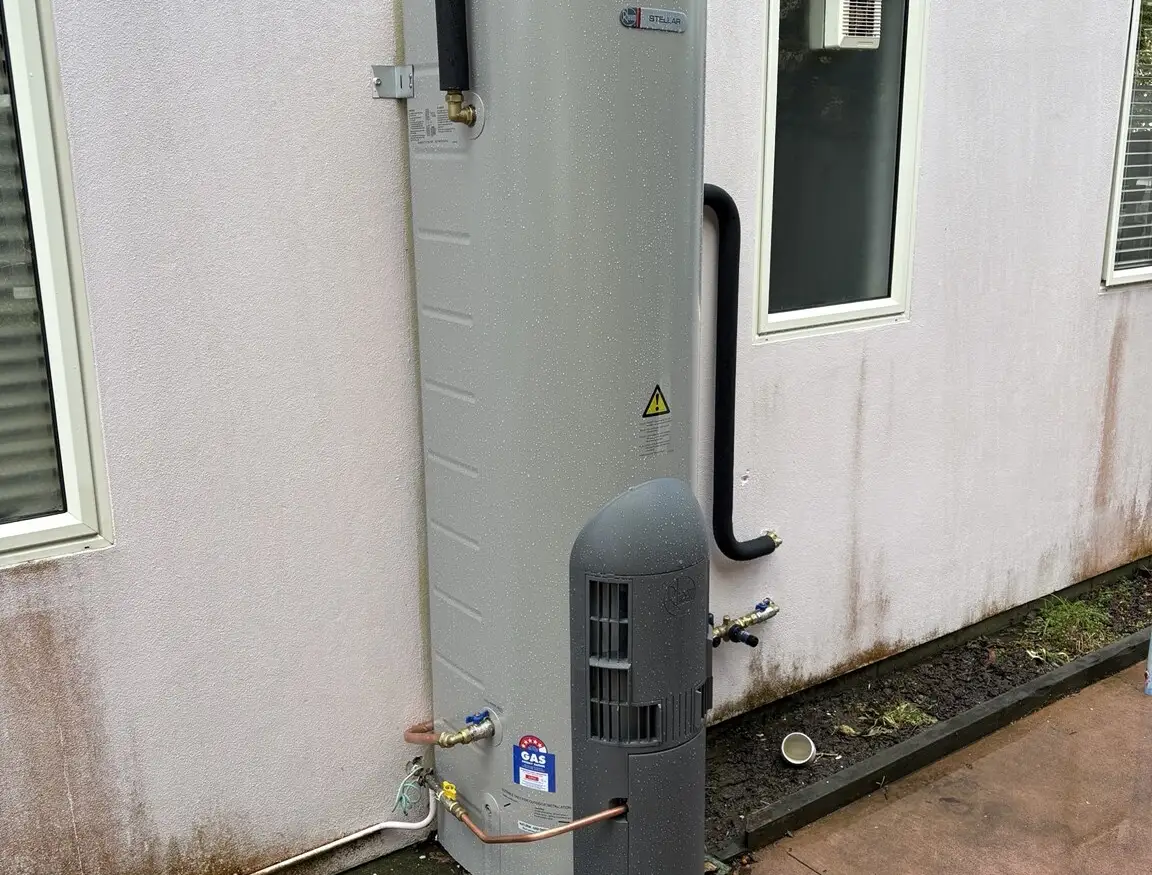
| Gas storage (for example Rheem Stellar) | Anodes | Anodes, then the tank. The burner and gas control are serviceable | 10 years (Rheem Stellar) |
| Heat pump (for example Rheem MPi-325) | Anode | The heat pump module or the tank, whichever goes first | Tank 5 years, sealed heat pump system 2 years |
Warranties are from Rheem’s Domestic Warranty Guide and Rinnai’s owner guides.
Three things wear an anode out faster, or attack a tank that has none:
- Your water supply. Rheem brings anode inspection forward on softened water, bore water, or a supply that switches between a rainwater tank and town water. Rinnai treats bore and tank water as corrosive until tested, and requires an inline filter where the supply carries silt.
- The wrong anode. Anodes are matched to the water. Rheem warns that the wrong one “may shorten the life of the water heater cylinder”.
- Water sitting still. Rinnai says stagnant water “will promote corrosion” and recommends flushing a system that isn’t in use every eight weeks. That matters for a holiday home left empty over winter, or a rental between tenants.
Does a cylinder need servicing, and does flushing help?
Yes, it needs servicing, but not the annual flush many websites suggest. That advice comes from overseas tank heaters. New Zealand owner guides ask owners to lift the relief valve every six months and leave the rest to a Licensed Plumber, chiefly the anode, which Rheem says can extend the cylinder’s life if replaced in time.
| Who | What | How often |
|---|---|---|
| You | Lift the relief valve’s easing gear (see our guide to a dripping overflow pipe) | Every 6 months (Rinnai) |
| You | Keep the safe tray drain and cupboard clear, and note the installation date somewhere you’ll find it | Ongoing |
| Plumber | Inspect the anode, replace if needed | Rheem enamel: at 8 years (Optima 10). Rinnai: every 5 years. Earlier on softened, bore or tank water |
| Plumber | Replace the relief valve | No more than 5 years (Rinnai) |
| Plumber | Full service: valves, element (descaled in hard water areas), safe tray drain | Rinnai: year 5, then every 24 months. Rheem gas and heat pump: every 5 years |
What are the five signs a cylinder is ending?
Rust in the hot water or on the casing, water from the tank itself, and rumbling as it heats are the physical signs. The other two are circumstances: a cylinder past its tank warranty whose anode has never been checked, and repairs that keep coming. Any one is a reason to book an inspection.
| Sign | What it usually means | What to do |
|---|---|---|
| 1. Rusty or brown water from the hot taps only | Run the cold tap beside it. If the cold is clear and the hot isn’t, the tank is corroding inside. If both are discoloured, the cause is the supply or the pipes | Book an inspection. A new anode can buy time on a sound tank; a corroding tank is a replacement |
| 2. Water around the base or in the safe tray, or rust low on the casing | A fitting above is running down inside the casing, or the tank has corroded through | Isolate the cylinder and follow our guide to a cylinder leaking from the bottom |
| 3. Rumbling, crackling or popping while it heats | Scale on the element and in the base of the tank | Have the element checked and descaled. On an older cylinder with other signs, start planning |
| 4. Past its tank warranty, anode never checked | Nothing has failed yet, but the tank may already be unprotected | Have the anode inspected. It is the simplest way to judge how much life is left |
| 5. Repairs keep coming: a second element, the relief valve again, the thermostat | Scale or water quality working on the whole cylinder | Ask for an honest view on the tank before paying for the next part |
Some faults sound terminal and aren’t. A few drips from the overflow while heating, condensation from a gas or heat pump unit, no hot water after a tripped breaker, and a shower that runs cooler than the kitchen tap are all normal or routine repairs. Our guides to no hot water and cylinder temperature and tempering valves cover those.
Repair or replace: how does age change the answer?
Use the tank warranty, not a rule of thumb. Inside it, almost every fault is a repair, and a leaking tank is a warranty replacement. Past it, valves and elements are still worth repairing on a sound tank. A corroding or leaking tank is a replacement, and so, usually, is a cylinder that keeps needing parts.
| Fault | Inside the tank warranty | Past the tank warranty |
|---|---|---|
| Relief, expansion or tempering valve | Repair | Repair |
| Element or thermostat | Repair | Repair if the tank is sound. On an old tank we check it first, because disturbing the element can start a leak |
| Anode used up, tank sound | Replace the anode | Replace the anode |
| Rusty hot water, tank corroding | Warranty claim | Replacement |
| Tank leaking | Manufacturer replaces the cylinder; labour depends on the labour period | Replacement |
| Several faults in a row | Repair and ask why | Usually replacement |
The warranty runs from the installation date if you can prove it, otherwise from the date of manufacture on the cylinder’s label.
What if your cylinder fails just after its warranty?
The manufacturer’s warranty is not the limit of your rights. Under the Consumer Guarantees Act, goods must last a reasonable time, and a business cannot limit its obligations to the warranty terms. A cylinder that fails soon after its warranty ends may still be covered by the business that supplied it.
Consumer NZ handled exactly this: a low pressure cylinder that leaked just after its five-year warranty. Its advisers said failure “at just over 5 years could accurately be described as premature”, and the manufacturer agreed to cover it. Keep the installation invoice, photograph the label and the failure, and have the attending plumber record what failed and why. Work by an unlicensed person, which Rinnai says voids its warranty, and skipped servicing both weaken a claim.
Is it worth replacing a cylinder before it fails?
Often, if it is well past its tank warranty and showing signs. A planned replacement lets you choose the type, timing and position, and avoids the water damage that insurers treat as gradual and largely exclude. If it shows no signs, start with a service and an anode check, which tells you whether you’re planning for next year or years away.
Planned replacement is also the moment to change what you have: low pressure to mains pressure, indoors to outdoors, or a heat pump unit. Our leaking cylinder guide sets out those options.
What we do when we check an older cylinder
We read the label, check the anode, valves, element and safe tray drain, and tell you plainly how much life we think is left. If a repair makes sense, we do it. If the tank is near the end, we explain the options, quote in writing before starting, and replace it to code. See our hot water cylinder page for servicing, repairs and replacements.