
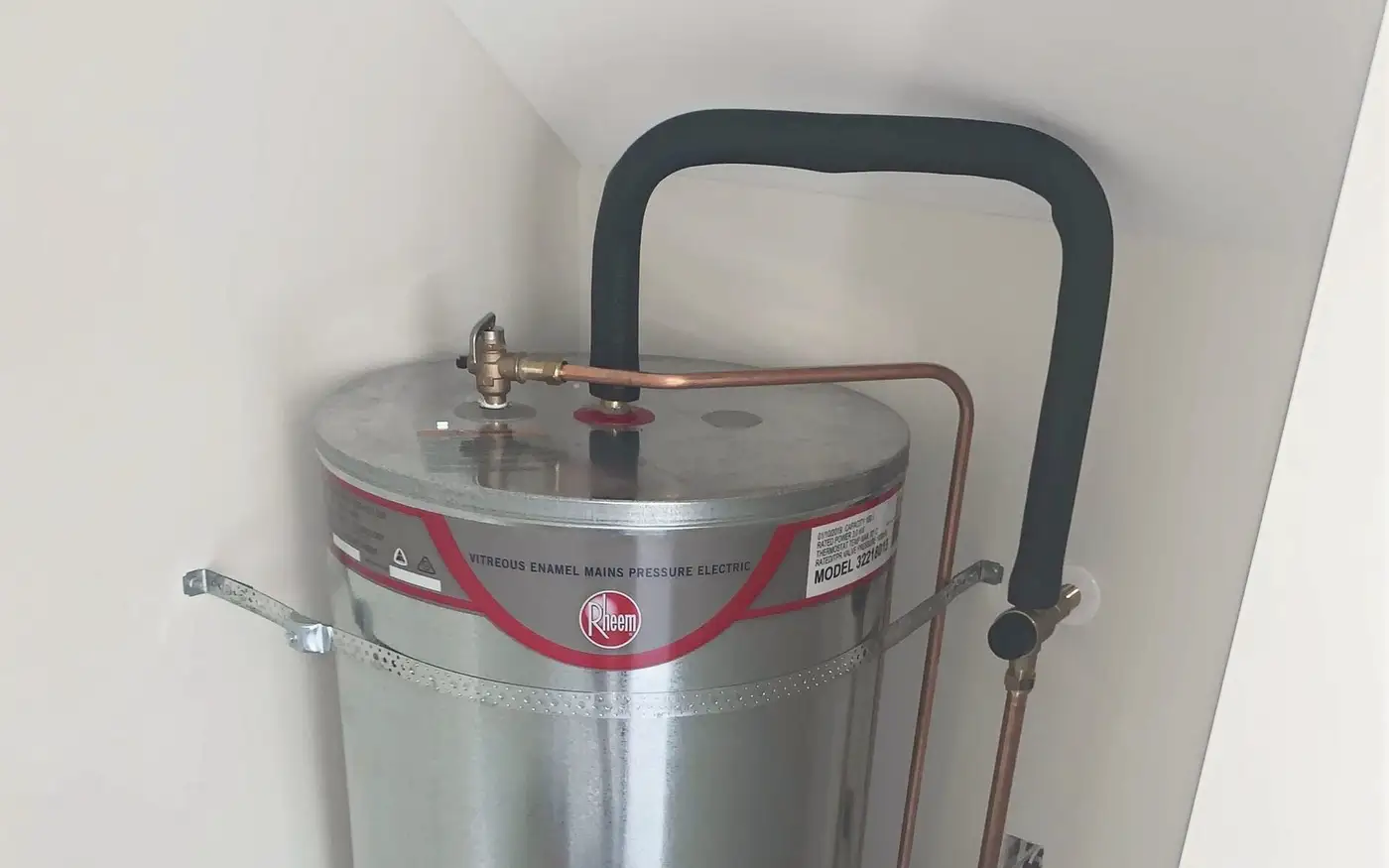
The pipe most people call the cylinder overflow is the drain line from one of its safety valves. It runs outside, usually over the gully trap, so you can see when a valve lets water out. Some dripping is part of how the cylinder works. Some means a part has failed.
This guide explains how to tell the difference, what each kind of drip means, and which ones need a plumber. The figures come from Rheem and Rinnai’s New Zealand owner guides.
Is it normal for a hot water cylinder overflow pipe to drip?
Yes, a little. Water expands by about a fiftieth of its volume as it heats. In a mains pressure cylinder that extra water has nowhere to go, so a valve opens and lets it out through the drain pipe. A few drips while the cylinder is heating, stopping once it’s hot, is normal.
Rheem’s owner guides put the line at a bucketful in a day. If either valve lets out more than that, something needs attention.
To put numbers on it: water heated from cold tap temperature to about 65°C grows by roughly 2 per cent, which is where Rheem’s “fiftieth” comes from. (Some online answers say 3 per cent; that’s closer to water heated to 80°C.) So a 180 litre cylinder heating from cold lets out three to four litres, and the reheat after a shower is about a litre. If you’re unsure, stand a bucket under the drain for a day.
You may also notice the dripping stops when someone turns on a hot tap. That’s expected: running a tap releases the pressure, so the valve closes until the taps are off and the cylinder heats again.
Which pipe is dripping?
Most cylinders have more than one valve with a drain, and knowing which one is running narrows down the cause.
| Valve | Where it is | What it does |
|---|---|---|
| Expansion control valve | On the cold water pipe going into the cylinder | Opens while the cylinder heats to let expanded water out. Small drips of cold water are normal |
| Temperature and pressure relief valve | On top of a mains pressure cylinder, with a small lever | The main safety device. Opens if pressure or temperature gets too high, and can let out a little water while heating |
| Vent pipe (open vented low pressure cylinders) | An open pipe running up through the roof | Lets pressure escape. A steady flow points to incoming pressure; hot water pouring out means turn the power off |
On a typical mains pressure installation, the valves open at different pressures. Rinnai gives a common setup: a pressure limiting valve holding the incoming water at 500 kPa, the expansion control valve opening at 750 kPa and the relief valve at 850 kPa. The expansion valve is set to open first, so in normal use it does most of the dripping. Some older installations have no expansion valve, so the relief valve drain does all of it. If the pressure limiting valve is set too close to the other valves’ settings, they drip constantly, and adjusting or replacing it fixes that.
A note on names: “PRV” can mean pressure relief valve or pressure reducing valve. They’re different parts. The pressure reducing (or limiting) valve sits on the incoming cold pipe and keeps street pressure down to what the cylinder can take.
Plenty of older North Shore homes still have a low pressure copper cylinder. These come in two setups: open vented, with a vent pipe up through the roof, and valve vented, with a relief valve and drain instead. On an open vented cylinder, check the roof vent as well as any drain pipe.
Is it the cylinder, or another pipe?
Several pipes can end up dripping outside the house, and not all of them come from the cylinder:
| What you see | What it usually is |
|---|---|
| A small copper pipe, often ending over the gully trap | The cylinder’s relief or expansion valve drain |
| An open pipe on the roof | The vent on an open vented low pressure cylinder |
| A plastic drain near the bottom of a gas cylinder or heat pump unit | A condensate drain. Dripping while heating is normal: Rheem says a gas cylinder can let out several litres a day in cool weather |
| A wider pipe from the cylinder cupboard floor | The safe tray drain. Water here means something inside the cupboard is leaking |
| A pipe near the toilet | The toilet cistern overflow, which means the cistern valve isn’t shutting off |
Condensate is not mains water, and it’s no cause for concern. A safe tray drain that’s running is: get the cylinder and its fittings checked.
When is a dripping overflow pipe a fault?
When it runs all day whether or not the cylinder is heating, lets out more than a bucketful in a day, or discharges hot water in a steady stream. Rheem’s owner guides describe three patterns, and each points to a different cause:
| What you see | Likely cause | What to do |
|---|---|---|
| A constant dribble | Grit or scale on the valve seat, so it can’t close fully | Ease the relief valve lever for a few seconds (steps below). If it keeps dribbling, the valve needs replacing |
| A steady flow, often at night | Incoming water pressure rising above the cylinder’s rating | Fit a pressure limiting valve, or replace the one you have if it has failed |
| Hot water pouring out until the cylinder runs cold, then stopping while it reheats | The cylinder is overheating, often a thermostat fault | Turn off the cylinder’s power at the switchboard (or the gas control knob on a gas cylinder) and have it inspected |
One thing not to do: turn the thermostat down to stop a drip. It doesn’t fix the cause, and New Zealand’s Building Code requires stored hot water to be kept at 60°C or more to control Legionella bacteria.
What should you do if hot water is pouring out?
Turn off the power to the cylinder. Use the switch or circuit breaker marked “water heater” or “hot water” at your switchboard, or the isolating switch beside the cylinder. On a gas storage cylinder, Rheem says to turn the gas control off with the knob on top of the gas control thermostat. Leave the valves alone, keep clear of the drain outlet because the water is hot, and have a plumber check the thermostat before the power goes back on.
Rheem’s guides are clear on this: if the cylinder’s thermal cut-out has tripped, it indicates a possibly dangerous situation, and only an authorised service person should adjust or reset it.
How do you ease the relief valve?
Rheem recommends operating the relief valve’s easing lever at least every six months. It clears scale from the valve seat and proves the valve isn’t blocked. It’s also the first thing to try for a constant dribble.
- Find the relief valve on top of the cylinder, with the small lever on its side.
- Check nobody is standing near the drain outlet outside. The water that comes out is hot.
- Lift the lever gently until water flows from the drain line.
- Hold it for a few seconds, then lower it gently. Don’t let it snap shut, and don’t flick it up and down. Rheem and Rinnai both say to operate it gently, and a sudden release can leave the valve dripping.
- Check the drain over the next hour or so. It should stop, apart from normal heating drips.
If your expansion valve on the cold pipe also has a lever, ease it the same way.
If water doesn’t flow freely when you lift the lever, or the valve won’t close and keeps running, it needs replacing.
How long does a relief valve last?
Rinnai and several of Rheem’s New Zealand guides say the relief valve should be checked or replaced at intervals of no more than five years, and more often where the water is hard. Rheem’s heat pump guide gives the expansion valve the same interval. So on a cylinder that’s ten years old and has never had its valves done, a dripping drain is often just age.
Can you block or cap the overflow pipe?
No. Rheem and Rinnai both say a relief valve or its drain must never be blocked, plugged or removed without a replacement. Without it, pressure in the cylinder has nowhere to go. Swapping in a valve with a higher pressure rating to stop the drip is ruled out for the same reason: both manufacturers say never to fit one. The drain runs to a visible point outside on purpose: a drip you can see is the early warning.
A dripping drain is fixed at the source: the valve, the incoming pressure or the thermostat.
Does a dripping overflow pipe cost you money?
Yes, in two ways. Every litre that runs down the drain passes through your water meter first, so you pay for it on your water bill. If it’s hot water, you’ve also paid to heat it. Rheem lists a discharging valve as one of the causes of a high power bill.
Watercare lists a relief valve dripping into the gully trap as one of the first things to check when a water bill jumps. If yours has, our guide to water leaks and Watercare’s leak allowance explains who pays and how to claim part of it back.
Fixing the cause, not just the valve
A new valve on a cylinder with high incoming pressure soon starts dripping again. When we look at a dripping overflow, we check the incoming pressure, the pressure limiting valve, the expansion and relief valves, and the thermostat, then replace what has actually failed. You get the price before we start.
If the water is coming from the cylinder itself rather than a drain pipe, that’s a different problem. See our hot water cylinder page for repairs and replacements, or water mains and pressure if the pressure coming into the house is the issue.