
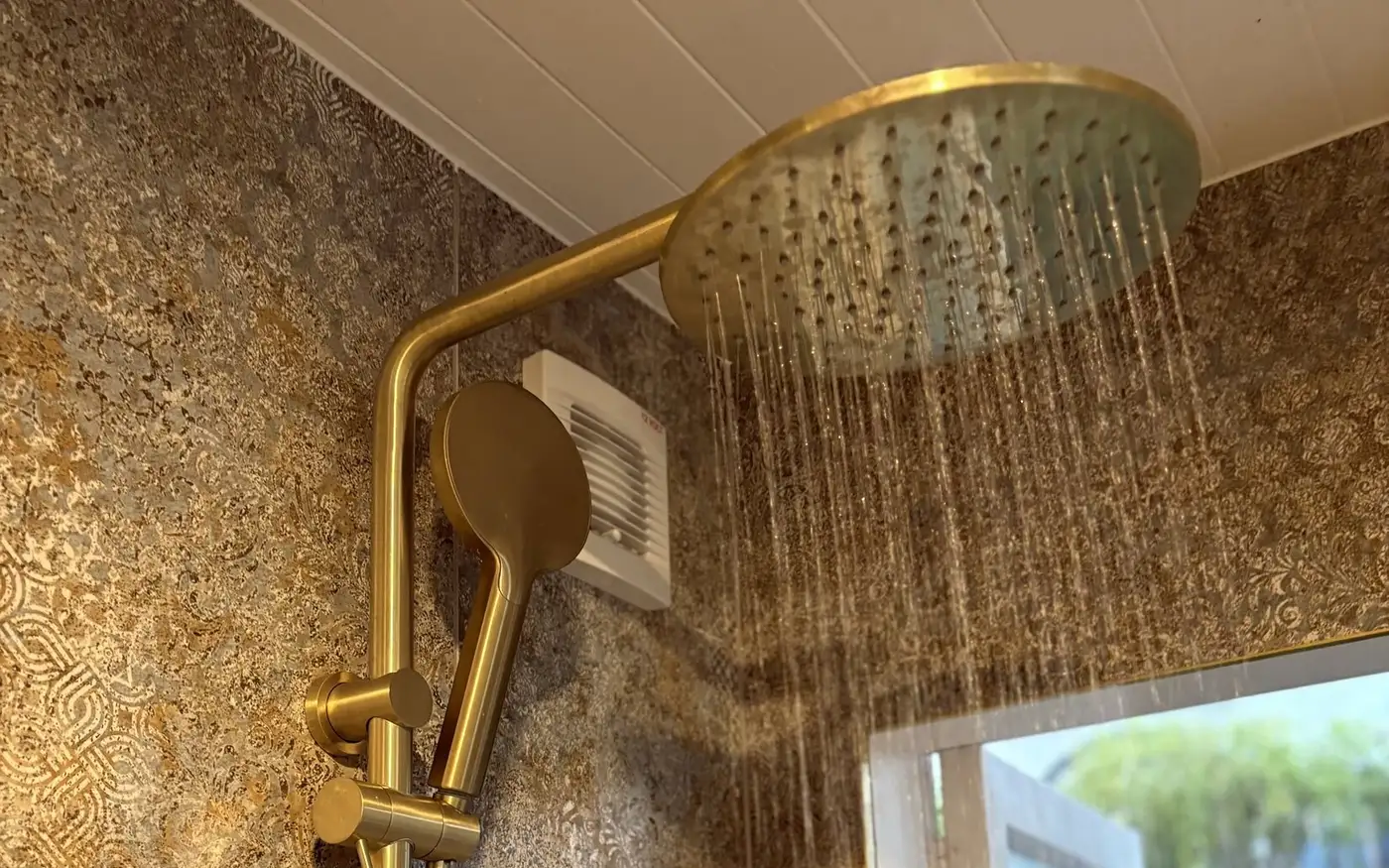
Low water pressure is a symptom, and the cause depends on where it shows up. Every tap, one shower, or only the hot side each points to a different part of the house, and to a different person to call. Five minutes with two taps tells you which.
Most of it you can check yourself at the boundary, the shower head and the cylinder label. Anything that means opening a mixer, adjusting a valve on the cylinder or cutting into a pipe is a job for a licensed plumber.
Where is the pressure low?
Run the cold tap at the kitchen sink, then the hot. Do the same at the weak shower or basin. Weak hot and cold everywhere points to the supply. One weak fitting points to that fitting. Strong cold with weak hot at every tap points to the hot water system. Then find your pattern in the table.
| What you see | Most likely cause | Check first | Who fixes it |
|---|---|---|---|
| Every tap, hot and cold, dropped suddenly | Outage or work in the street, a part-closed meter tap, a leak on your supply pipe | Watercare outages, neighbours, meter tap fully open, meter test | Watercare on the street side, a plumber on yours |
| Every tap, worse over months or years | Corroded or ageing supply pipe, a failing pressure reducing valve, a slow hidden leak | Meter test, rusty water first thing in the morning | Plumber |
| A shower collapses when another tap runs | Supply pipe or hot water system too small for two outlets | Which outlet causes it, and whether hot or cold drops | Plumber |
| One shower or tap, hot and cold | Scaled head, flow restrictor, mixer filters or cartridge | Run the shower with the head off | You first, then a plumber |
| Hot weak at every tap, always has been | A low pressure hot water cylinder, working as designed | The label on the cylinder | Plumber, if you want more |
| Hot weak at every tap, new or getting worse | A valve on the hot side, the header tank, the cylinder’s cold feed | Cold valve into the cylinder fully open | Plumber |
| Hot weak in the bathrooms, strong at the kitchen | The tempering valve | Water temperature at a bathroom basin | Plumber |
What is normal water pressure in Auckland?
Watercare “normally” supplies homes with at least 200 kPa and “a flow rate of at least 25 litres per minute” at the meter. That’s the cold supply. Hot water from a mains pressure cylinder runs close to it. From a low pressure cylinder, it runs at roughly 30 to 120 kPa, according to BRANZ’s Level guidance.
You can check the flow without a gauge. Fill a 10-litre bucket from the outside tap nearest the meter with nothing else running. At Watercare’s 25 litres a minute, it fills in 24 seconds. Much slower than that, with the meter tap fully open, and the problem is between the street and that tap.
Height matters too. Pressure falls by about 10 kPa for every metre a house sits above the main, so a home up a long driveway gets less than one at street level from the same pipe.
Why has the pressure dropped suddenly at every tap?
Usually something outside the house, such as an outage or a repair in the street. Check Watercare’s outages page and ask a neighbour. If the street is fine, make sure the meter tap is fully open by turning it anti-clockwise, as Watercare advises, then rule out a leak on your own supply pipe.
The meter tap sits in the meter box at your boundary. Meter changes, nearby repairs and your own plumbing work are all chances for it to be left half on. To rule out a leak, read the meter, use no water for a few hours and read it again; our guide to water leaks and Watercare’s leak allowance covers that test and who pays.
Some homes have a pressure reducing valve on the supply pipe, fitted where the street pressure runs high. When one fails, it can cut the whole house back sharply.
After any outage, run each tap until it flows smoothly. A burst or repair can stir sediment through the main, and it collects in tap aerators and mixer filters. A tap that stays weak after the supply is back is often just a blocked aerator.
Why does the pressure drop when another tap runs?
Some drop is normal; a collapse isn’t. The Building Code’s Acceptable Solution sizes pipes so the kitchen sink and one other fixture both get their full flow at the same time. If the shower dies whenever the kitchen tap opens, the supply pipe or the hot water system can’t do that.
The design flows are modest: 0.2 litres a second at the kitchen sink and 0.1 at the shower. The usual culprits are old supply pipe narrowed inside by corrosion, a long run in small-bore pipe, or a valve somewhere that was never fully reopened.
Galvanised steel, common in older Auckland homes, corrodes from the inside and slowly shrinks the bore; rusty water first thing in the morning is the tell. In homes from the 1970s and 80s, grey Dux Quest pipe fails at the fittings instead, and a partial split can show up as weak flow in one area. Our Dux Quest guide shows how to spot it.
Why is the pressure low in the shower only?
If every other tap runs well, the fault is in that shower: the head, the hose or the mixer. Take the head or handset off and run the shower. If the flow is strong without it, the head is the problem. If it’s still weak, the restriction is in the mixer or the pipe behind it.
The head. Scale blocks the nozzles over time. Common advice online says to soak the head in vinegar overnight and clear the holes with a toothpick. Methven’s care instructions say the opposite for its heads: flex the rubber nozzles with a finger while the water runs, use a limescale remover for no more than 10 minutes, and never use sharp objects or acidic cleaners. On brushed brass, black or nickel finishes, follow the maker’s instructions.
The wrong head for the system. Water-saving heads limit the flow, and some are built only for mains pressure. Methven labels these for “mains pressure installations above 150kPa”, and its “all pressure” products for anything above 35 kPa. A mains-only head on a low pressure system will trickle, so check the label before you buy.
The mixer. Grit caught in the mixer’s inlet filters, or a worn cartridge, cuts the flow; Methven and other mixer makers list both as causes. If only the hot or only the cold is weak at that one shower, the cartridge or the isolating valve behind the wall plate is the likely cause.
Why is only the hot water pressure low?
Usually because of how the house was plumbed. A low pressure cylinder supplies hot water at a fraction of mains pressure while the cold arrives at full mains pressure, so strong cold beside weak hot is normal for it. As Watercare puts it, your cylinder determines “whether you have mains (equal) or low (unequal) water pressure”.
How do you tell if you have a low pressure cylinder?
Read the label on the cylinder: it says “mains pressure” or “low pressure”. Methven’s guide to choosing tapware starts with the same check, and notes that gas and heat pump water heaters run at mains pressure. Other signs of low pressure are a copper vent pipe through the roof, a header tank in the roof space, or a large valve on the cylinder’s cold pipe.
An open-vented system gets its pressure from the height of the header tank or vent pipe, and a valve-vented one from a pressure limiting valve on the cold feed. Either way the ceiling is low: Rheem rates its low pressure copper cylinders to 76 kPa, and its Heavy Head models to 120 kPa. BRANZ puts a low pressure shower at about 7 litres a minute, against 12 to 20 on mains pressure, and notes that unequal pressure makes balanced flow to a shower difficult.
What makes hot pressure drop when it used to be fine?
Something on the hot side has changed: a valve, the header tank, or on a califont, the supply or the demand. Where the weakness shows, at every hot tap or only in the bathrooms, narrows it down. Only the first check below is an owner’s job.
- The cold feed. The valve on the cold pipe into the cylinder must be fully open. Our no hot water checklist shows where to find it.
- The pressure limiting valve. On a low pressure system, a blocked or failing one cuts flow to every hot tap.
- The header tank. A sticking float valve lets the level drop, and the hot pressure with it.
- The tempering valve. A failing one cuts hot flow in the bathrooms while the kitchen, which it doesn’t serve, stays strong. Our guide to tempering valves covers the other signs.
- A califont. It needs enough incoming pressure: Rinnai’s INFINITY A26 is rated from 200 kPa, Watercare’s minimum. Its model number is its hot water output in litres a minute at a 25°C temperature rise, so it delivers less hot water a minute in winter, when the incoming water is colder. If yours struggles to run two showers, it may be undersized for the house; see califont or cylinder? for how sizing works.
Can you get more pressure from a low pressure system?
A little, within the cylinder’s rating, which caps any valve change. Beyond that you either make better use of the pressure you have, with fittings built for it or a pump, or change the system to mains pressure. Which suits depends on the cylinder’s age, the pipework and the house, and a Licensed Plumber can tell you after seeing it.
- Fittings made for the system. Methven’s Fastflow II mixers are built for unequal pressure, and its Hyperflow mixers for equal low pressure up to 120 kPa.
- A higher-rated valve. Pressure limiting valves come in fixed ratings, and only a cylinder built for more pressure can take a higher one.
- A pump on the hot supply, sized for the shower it serves.
- A mains pressure upgrade, to a mains pressure cylinder, a califont or a heat pump. It’s usually done when the old cylinder is due or the bathroom is being redone. The mixers may need adjusting afterwards, and older plastic pipe should be checked before it goes under full mains pressure.
Should you call Watercare or a plumber?
Watercare, if the cold is weak at every tap and there’s no outage listed: its network is the likely cause. A plumber, if the problem is only hot water, one fitting, or anything on your side of the meter. Watercare can’t work on private pipes, so a fault between the meter and the house is always a plumber’s job.
Watercare takes low pressure reports through the digital agent on its website, or on (09) 442 2222, option 1. Before you call either, note which taps are weak, hot, cold or both, when it started, and anything that happened just before: an outage, work in the street, a new shower head.
What we do when you call us about low pressure
We measure the pressure and flow at the meter, then at the weak outlet, with nothing running and with taps open. Comparing the two finds where the pressure is lost: the street, the main, a valve, the cylinder or the fitting. You hear what we found and your options, with the price in writing before we start.
Our water mains and pressure page covers mains repairs, pressure reducing valves and mains pressure upgrades.