
A water bill that suddenly jumps is often a leak somewhere between the street and your taps, though not always, and the checks below rule out the other causes. This guide explains who is responsible for fixing it in Auckland, how to confirm the leak yourself, and how to claim Watercare’s leak allowance once it’s fixed.
Everything here is checked against Watercare’s own published rules. Watercare supplies the North Shore along with the rest of metropolitan Auckland, so this applies whether you’re in Birkenhead, Browns Bay or Beach Haven.
Who pays for a water leak on your property in Auckland?
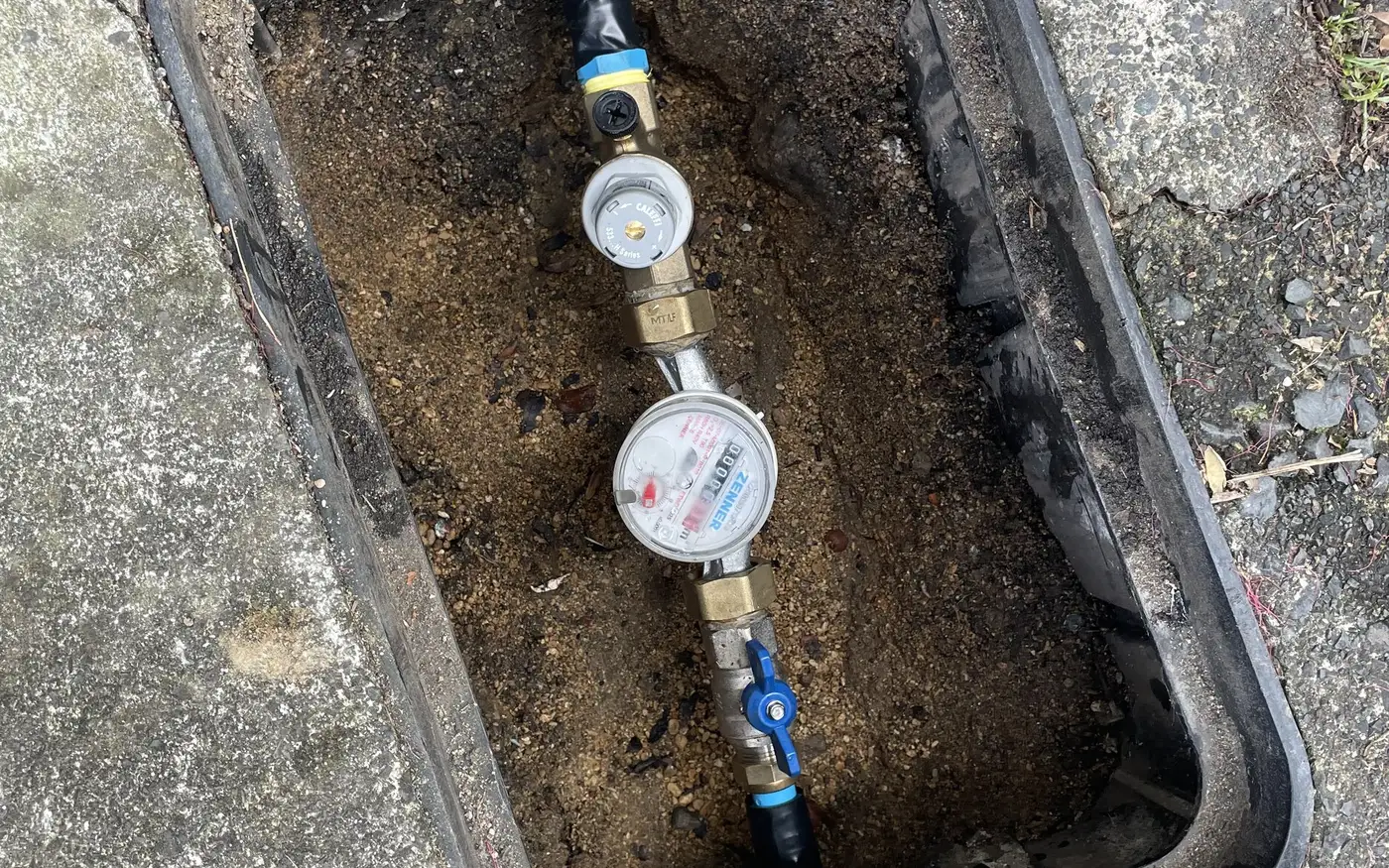
It depends on which side of your water meter (the toby) the leak is on. Watercare owns the pipes up to the outlet of the meter, so a leak on the street side is theirs to fix and won’t touch your bill. Anything on your side of the meter, from the pipe under the lawn to a dripping tap, is the property owner’s to fix and pay for.
Watercare calls that dividing line the point of supply: the outlet of the meter fitting closest to your private pipe. It applies whether the meter sits on the footpath or inside your boundary.
| Where the leak is | Who fixes it | On your bill? | What to do |
|---|---|---|---|
| Street side of the meter | Watercare | No | Report it: (09) 442 2222, option 1 |
| Inside the meter box | Watercare | It can | Call (09) 442 2222, option 2 |
| Between the meter and the house | Owner | Yes | Plumber, then claim the allowance |
| Inside the house | Owner | Yes | Plumber, then claim the allowance |
| A rental | Landlord, generally | Yes | Tell the landlord straight away |
A leak inside the meter box is Watercare’s to repair, and because it’s on the meter it can push up your bill, so Watercare may adjust your account. Street-side leaks can also be reported through LiveChat on Watercare’s website. Rentals have their own rules on who pays for the lost water; see who pays in a rental below.
Watercare’s contractors can’t repair private pipes for liability reasons, even if you offer to pay them. Your side of the meter is a job for a licensed plumber.
How do you know if you have a leak?
Do a meter test. Pick a time when nobody will use water (overnight is easiest), write down the meter reading, then run no taps, flush no toilets and use no water for at least four hours. Read the meter again. If the number has moved, water is escaping somewhere on your side.
On a smart meter, a droplet symbol showing while nothing in the house is running means the same thing.
Before you go leak hunting, rule out the other reasons a bill jumps:
- A catch-up bill. Mechanical meters are read every second month, with an estimated bill in between. If the estimate was low, the next actual read makes up the difference.
- Extra use. Guests staying, more washing, or watering the garden all show up.
- A misread meter. Compare the reading on your bill with the meter itself.
Watercare’s smart meters record use every half hour, and its app shows your daily and half-hourly use and flags possible leaks. If you have one, a leak shows as use that never drops to zero overnight.
Is it a leak, groundwater or wastewater?
Look at the water. Clear water coming up from an unknown source is most likely a leak. Orange or oily-looking water that disappears as the ground dries is usually groundwater. Grey or dirty water is likely wastewater, and Watercare asks you to call them before a plumber.
| What you see | Most likely | Who to call |
|---|---|---|
| Clear water leaking or pooling | A water leak | A plumber if it’s on your side of the meter; Watercare if it’s on the street side |
| Orange or oily water that dries up | Groundwater (rain that has soaked in and resurfaced) | Nobody. Watercare says you don’t need to report it |
| Grey or dirty water | Wastewater | Watercare first, on (09) 442 2222, option 1. Take photos |
| Stormwater affecting a public drain, pond or road | Stormwater | Auckland Council, 09 301 0101 |
The meter test settles it: if the meter moves with everything off, it’s a supply leak.
Where do household leaks usually hide?
Most leaks we find on North Shore properties turn up in a handful of places. Check these, in this order:
- Taps. A tap that won’t fully turn off, inside or outside.
- Toilets. Put a few drops of food colouring in the cistern and wait without flushing. If the colour appears in the bowl, the cistern is leaking through.
- The hot water cylinder. Look at the relief valve drain, usually over the gully trap outside. A constant drip or trickle there is water you’re paying for.
- Behind the washing machine and dishwasher. Look for damp, staining or swollen board.
- Outside. In dry weather, look for a patch of lawn, garden or driveway that stays damp or greener than the rest.
- Listen. With everything off, can you still hear water running in a wall or under the floor?
If the meter moves but taps, toilets and the cylinder are all dry, the leak is probably underground or inside a wall. That’s common in older Auckland homes, especially those with galvanised steel supply pipe or grey Dux Quest pipework, which was fitted in a lot of houses through the 1970s and 80s and tends to let go at the fittings with age.
Why does a leak cost more than the water?
Because you pay for wastewater on it too. Watercare charges residential wastewater at 78.5 per cent of your metered water use, on the assumption that most water entering a home goes down the drain. Water from a leak under the lawn never reaches the drain, but it’s still metered, so it’s charged as water and, mostly, as wastewater.
That’s also why Watercare’s second leak allowance, for a repeat leak within two years, covers the excess wastewater charge.
What is Watercare’s leak allowance?
It’s a partial credit on your water account for water lost through a leak on your side of the meter, once you’ve fixed it. Watercare works out your excess use against your average from your previous two meter reads and credits it on your next bill. It rewards fixing leaks quickly; it doesn’t cover a leak left running.
A few details worth knowing:
- If you haven’t been at the property for a full year, Watercare uses a typical average daily use instead of your own history.
- A second leak within two years can be claimed too, but you must attach a plumber’s invoice, and the second allowance covers excess wastewater charges only.
- Business accounts get an allowance for wastewater charges only.
Who can claim the leak allowance?
You’re eligible if you fixed the leak within 21 days of Watercare’s letter or email about a higher-than-normal bill, or if you fixed it before any letter arrived. The account holder applies. If you’re a tenant with authority access to the account and you paid to fix the leak, you may be entitled to the allowance as well.
How do you claim the leak allowance?
Once the leak is fixed, the claim itself takes a few minutes:
- Keep the evidence. Ask your plumber to note on the invoice where the leak was and the date it was fixed, and write down the meter reading before and after the repair. The invoice is compulsory for a second claim and useful for the first, because the timing is what Watercare checks.
- Apply online. Log in to Watercare’s MyAccount and select Apply for leak allowance in the top bar, or fill in the leak allowance form on watercare.co.nz.
- Apply within three months. Watercare’s terms count this from its letter or email about the high bill. If you fixed the leak before any letter arrived, count from the date of the repair. Sooner is better.
- Wait for Watercare’s letter. They aim to process applications within 10 working days. The letter tells you the allowance amount, what’s left to pay and your new due date.
- Pay the balance within 21 days of the date on Watercare’s response. The credit appears in the current charges section of your next bill.
If the allowance puts your account into credit, you can ask Watercare for a refund using their refund request form.
Who pays for leaked water in a rental?
The landlord fixes the leak and generally carries the extra water it caused. Under Tenancy Services’ rules, a tenant pays metered water only where the charge can be put down entirely to their own use. Citizens Advice notes the Tenancy Tribunal has had landlords pay all or part of a bill pushed up by a leak they didn’t repair.
For landlords and property managers:
- The Watercare account is always the owner’s. Watercare holds the property owner responsible for the charges, whatever the billing arrangement with the tenant.
- Take meter readings at the start and end of each tenancy, so everyone agrees what the tenant used.
- The allowance lands on the owner’s account. If your tenant has been paying the water, pass on their share of the credit.
- Ask tenants to tell you about leaks as soon as they notice them, and have a plumber you can send without a long wait. The 21-day window starts when Watercare’s letter arrives, not when you find out.
What gets a leak allowance declined?
Watercare lists four common reasons:
- The leak wasn’t fixed within 21 days of their high-bill letter or email.
- The application arrived more than three months after the leak was fixed.
- More than one leak application has been made for the same property in the last two years.
- Watercare believes the high use came from filling a pool, topping up a water tank, running irrigation or exterior cleaning.
The first one catches the most people. If you get a high-bill letter, book the plumber first and sort the paperwork after.
Why is my bill still high after the leak was fixed?
Usually because of how meters are read. Mechanical meters get an actual reading every second month and an estimate in between, based on your last normal reads. So the next actual bill can still include water lost before the repair. If that’s what happened, Watercare says to contact them so they can consider a further allowance.
Finding the leak without wrecking the house
A meter that ticks over with every tap off tells you there’s a leak, not where it is. We narrow it down before we open anything: isolating sections of the house, checking the meter and pressure, and following the pipe runs. Most leaks are found with a small, tidy opening rather than a wrecked wall, and you hear what the repair involves before we start.
You also get a written invoice showing what we found and fixed, which is what Watercare asks for on a second claim and what most insurers want to see. See how we handle leak detection, or if the pipe has already let go, our burst pipe repairs.