
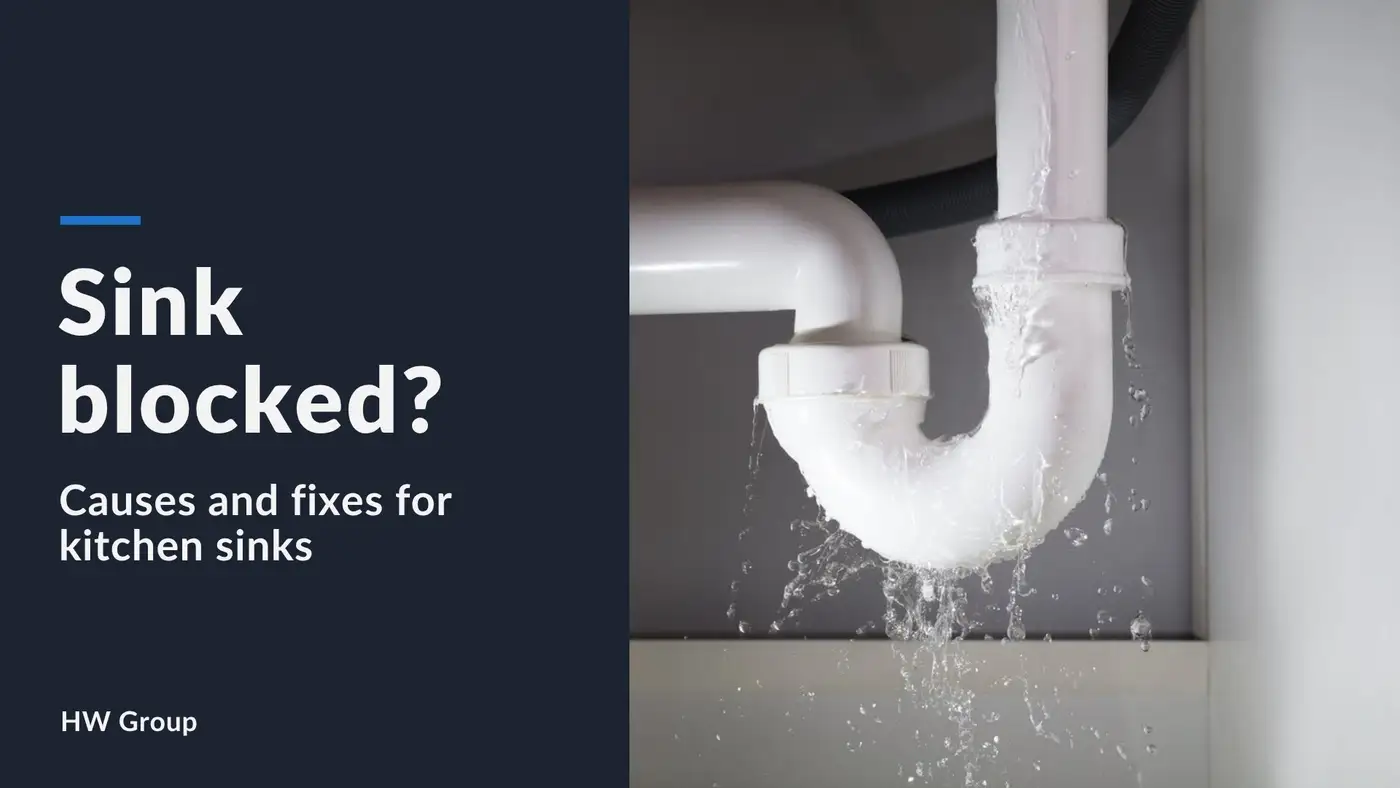
The kitchen sink takes more fat, food and dirty water than any other drain in the house, and usually the dishwasher’s waste as well. Most blockages and smells start close to the plughole, and those you can usually clear yourself.
Anything that means replacing the trap, cutting into the waste pipe or clearing the drain outside is a job for a licensed plumber or drainlayer.
Where is the problem?
Look at which outlets are affected and what the smell is like. One bowl, both bowls with the dishwasher, or several drains around the house each point to a different part of the pipework, and a rotten food smell has a different cause from a sewer smell. Find your pattern in the table.
| What you see | Most likely cause | Check first | Who fixes it |
|---|---|---|---|
| One bowl slow, the other fine | A blockage in that bowl’s waste, before the bowls join | Plunge that bowl with the other sealed | You |
| Both bowls slow, dishwasher water coming up in the sink | The trap or waste pipe they share | Plunge, then clean the trap | You first, then a plumber |
| Trap clean, sink still blocked | Fat or food set in the waste pipe through the wall or floor | Nothing more from the sink | Plumber |
| Sink slow, and the basin, shower or toilet slow or gurgling too | A blockage in the drain beyond the kitchen | The gully trap outside | Plumber or drainlayer |
| Rotten food smell, sink drains fine | Grease and food film in the trap and waste pipe | Clean the trap | You |
| Sewer smell from a sink that’s rarely used | The trap has dried out | Run the tap for a minute | You |
| Sewer smell with gurgling, or after another fixture drains | The trap being pulled empty: a vent or air admittance valve fault | Whether it comes back after running the tap | Plumber |
Why do kitchen sinks block?
Fat, oil and grease, with food scraps caught in them. Fat goes down the sink as a liquid, cools and sets on the pipe wall, and every scrap that passes sticks to it. Watercare’s advice is direct: “Don’t pour fats, oils or grease down the sink. They can harden and block your pipes and ours.”
Scrape fat and leftovers into the bin, or into the Auckland Council food scraps bin if you have one, as Watercare suggests. Wipe greasy pans with a paper towel before they go in the sink.
Running hot water or adding extra dishwashing liquid doesn’t solve it. Watercare’s guidance for commercial kitchens puts it plainly: “Using hot water and detergent will not prevent blockages; it only moves the grease further down the line.” The grease sets again where the pipe is cooler, out of reach.
Coffee grounds are the other common one. They don’t dissolve, and they settle into a sludge in the trap and any low spot in the pipe. Rice and pasta swell in water and do the same. A sink strainer catches most of it.
How do you unblock a kitchen sink?
With a plunger, the right way. Use a flat-bottomed cup plunger, with enough water in the sink to cover the cup. On a double sink, plug the other bowl’s plughole with a wet cloth or its plug, and cover the overflow, or the pressure escapes there instead of pushing on the blockage.
- Stop the water. Turn off the tap and don’t start the dishwasher.
- Plunge. Press down to seat the cup, then pump firmly 5 to 10 times, as WaterSafe advises, and pull it away.
- Run water to test. If it drains slowly, plunge again. If it’s still standing after a second go, move on to the trap.
If you’ve already poured a drain cleaner in, tell whoever clears the sink before anyone plunges or opens the trap. Baking soda and vinegar, boiling water and shop drain cleaners each have their limits, and our baking soda and vinegar guide covers what they can and can’t do.
Bent coat hangers and other improvised tools can scratch or damage the pipe, so leave them in the wardrobe.
How do you clean the trap under a kitchen sink?
Put a bucket under the trap, undo its nuts by hand, and tip out the water and whatever is in it. Scrub it, refit it with each rubber washer seated flat, tighten by hand, and run the tap while you check every joint for drips. Under the Building Code’s Acceptable Solution, traps must be removable or have a cleaning eye, so most are made for this.
Kitchen traps come in a few types:
- Bottle trap: a cylinder under the plughole. The base unscrews, which is usually where the grease sits.
- P or S trap: a U-bend held by two large nuts. Both undo by hand on most plastic traps.
- Double-bowl trap: both bowls feed one trap, often with the dishwasher hose joined on. BRANZ’s guidance allows one trap to serve two sinks and a dishwasher.
Wear gloves; the water in a blocked trap is greasy and smells. If the nuts won’t move by hand, or the trap is cracked or brittle, stop there. Replacing a trap or changing the waste pipework is restricted plumbing work under the Plumbers, Gasfitters and Drainlayers Board’s rules, and a job for a licensed plumber.
If the trap comes off clean and the sink is still blocked, the blockage is in the waste pipe beyond it, where a plunger can’t reach. That needs a drain cable or a jetter.
Why is dishwasher water coming up in the sink?
Because the dishwasher usually drains into the sink’s trap or waste pipe. When that’s blocked, the dishwasher’s pumped water has nowhere to go but up the plughole. Clear the sink and the dishwasher drains normally again. If the sink drains well but the dishwasher doesn’t, check its hose.
Fisher & Paykel’s NZ installation guide sets out how the hose should run:
- A high loop. Where the hose joins the sink trap, it must rise to a loop at least 150 mm above the joiner, or as close to the underside of the benchtop as possible, on a support at least 750 mm off the floor.
- No kinks. The hose should run straight to the joiner, because a kink restricts drainage.
- An open spigot. A new sink trap’s dishwasher connection comes sealed. The installer must drill it out to at least 13 mm before fitting the hose. If a newly installed dishwasher won’t drain from day one, check this first.
- No standing water. The dishwasher must never drain into a sink or tub that’s holding water.
Other makers’ requirements differ, so check your own model’s guide.
Why does the kitchen sink smell?
Either grease and food are rotting in the trap and pipe, or drain air is getting past the trap’s water seal. A rotten food smell, with the sink draining normally, is the first. A sewer or rotten egg smell is the second: the trap has dried out, been pulled empty, or a vent has failed.
Grease film. Food and fat coat the trap and the pipe beyond it, and the smell rises every time water disturbs it. Cleaning the trap usually ends it.
A dry trap. The water sitting in the trap is the only thing stopping drain air coming up the plughole. In a sink that’s rarely used, such as a scullery or butler’s pantry sink, a bar sink, a bach or a rental between tenants, it evaporates. BRANZ notes that fixtures must be used regularly to keep their traps full. Run the tap for a minute and the smell should go.
A trap pulled empty. When a large volume of water rushes down the drain, it can suck the water out of a trap behind it; BRANZ explains that enough negative pressure draws the water out “thereby providing a route into the building for foul air and gases”. A vent stops that by letting air into the pipe. Gurgling as the sink empties, or a smell after the dishwasher or washing machine pumps out, points here.
The air admittance valve. Where there’s no vent pipe through the roof, the pipe often rises to a small one-way valve inside the cupboard. It opens to let air in as water flows, and closes again. One that sticks open lets drain air into the cupboard; one that sticks shut lets the trap be pulled empty.
If the smell is strongest outside the kitchen wall rather than at the plughole, the cause is often the gully trap. Our guide to a smelly or overflowing gully trap covers it.
Does a waste disposal unit change things?
Yes, a little. A waste disposal unit needs its own trap under the Building Code’s Acceptable Solution, so a blockage there can leave the other bowl draining normally. InSinkErator says fat, oil and grease should never go into a disposal, and that coffee grounds and eggshells should go in gradually with a strong flow of cold water. Your unit’s manual lists what it can take.
When is it more than a sink blockage?
When other fixtures are affected, or it keeps coming back. A basin, shower or bath that also drains slowly, a toilet that gurgles when the sink empties, or a gully trap that overflows when you run the sink all mean the blockage is in the drain beyond the kitchen. Clearing the sink won’t fix it.
Stop running the dishwasher and washing machine until it’s cleared, because they add volume the drain can’t take. A drain blockage is cleared from the gully trap or an inspection point outside.
A sink that blocks every few months, however careful you are, has a cause worth finding: a rough joint, ribbed flexible waste pipe that holds grease in its ridges, a section of pipe without enough fall, or an older pipe narrowed by years of fat. Clearing it again only resets the clock.
What we do when you call us about a blocked or smelly sink
We find where the blockage or smell is coming from first: the trap, the waste pipe, the vent or the drain beyond. Then we clear sink wastes and traps at the source, clean or replace traps and wastes, sort out waste disposal units, and clear main line blockages from the gully trap. Waste pipes that are broken or poorly laid are repaired by our licensed drainlayer.
You hear why it blocked and how to stop it coming back, and you get the price before we start. Our blocked shower and sink page has more on how we work.