
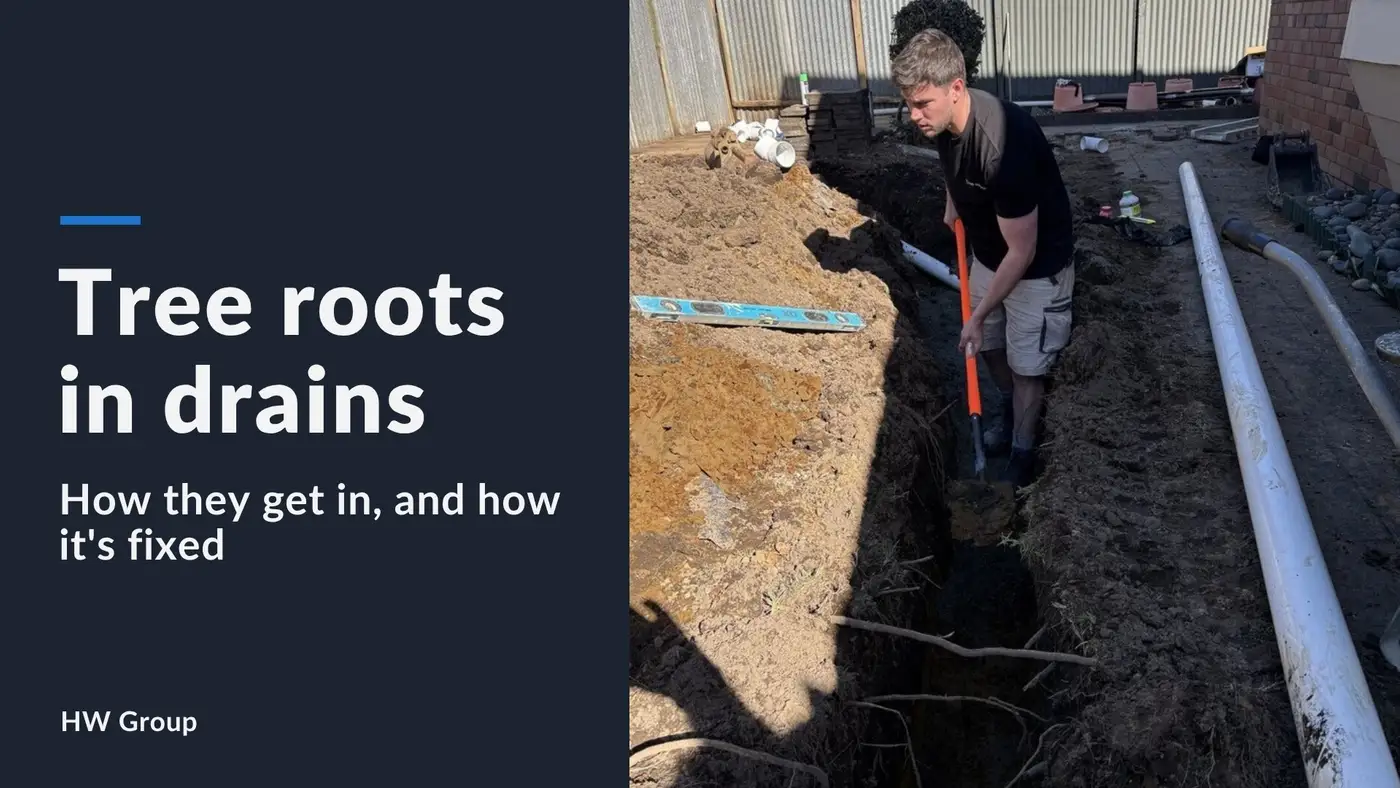
Roots in a drain raise two questions: how to get rid of them for good, and who pays. On the North Shore they usually turn up in an older earthenware line laid in short lengths, with a mature tree somewhere nearby.
This guide covers how roots get in, how to tell, and how the fix works. It also sets out what Watercare and Auckland Council publish about who is responsible, including when the tree is the council’s or a neighbour’s.
How do tree roots get into drains?
Through a gap that’s already there. A cracked pipe or a joint that has shifted lets moisture into the soil around it, roots grow toward the moisture, and fine roots work their way in. Inside the pipe they thicken into a mat that catches paper, fat and wipes until the drain slows or blocks.
Auckland Council’s own guidance makes the same point. Leaking pipes, it says, “due to poor construction, old earthenware, cracked and faulty joints, and degradation”, create moisture that draws roots toward the pipe. It adds that a properly built and maintained lateral, the pipe from your house to the public main, is designed to withstand normal tree roots.
Older North Shore homes were drained with earthenware or concrete pipe in short sections, so every joint is a possible way in. Auckland’s clay soils swell and shrink with the seasons and shift those joints over the years. Drains built to today’s Building Code acceptable solution must have flexible joints, so they aren’t damaged when the ground settles.
The tree doesn’t have to be close. Watercare says tree roots can spread 1.5 times further than a tree’s adult branches.
How do you know it’s roots?
The giveaway is a blockage that keeps coming back. Roots strain a drain rather than plug it, so water usually still gets through slowly while paper and solids build up behind them. The signs below point to a problem in the main drain rather than at one fixture.
| What you notice | What it suggests |
|---|---|
| The same drain blocks again weeks or months after it was cleared | Something in the pipe keeps catching waste: roots growing back, or a damaged section |
| Several fixtures drain slowly at the same time | A blockage in the main drain they share |
| The toilet gurgles when the shower or washing machine drains | The main line is partly blocked |
| The gully trap outside overflows when water runs inside | A blockage in the drain past the gully trap |
| Toilet paper comes back up, but the water slowly drains away | A root mat straining the flow rather than a solid plug |
| A strip of lawn along the drain line is soft, sunken or greener than the rest | Water escaping from a cracked or broken pipe |
If only one fixture is slow, roots are unlikely. Our blocked toilet guide walks through how to tell a fixture blockage from a drain blockage. If the gully trap is overflowing, our gully trap guide covers what to do while it is.
Who pays for tree roots in a drain in Auckland?
It depends first on where in the drain the roots are. Watercare looks after the public wastewater network and Auckland Council the public stormwater network. The private drain on your side of the connection is the owner’s to maintain and repair: Watercare says so, and Auckland Council says the same in its guidance on council trees.
Watercare calls the dividing line the point of supply. If the public sewer runs through your property, it’s the joint where your pipe meets the public pipe or manhole. If the public sewer runs outside your boundary, it’s where your pipe leaves the property. Watercare says “it’s your responsibility to maintain all the pipes, fittings and devices on your side of the point of supply”. A manhole on private land is still Watercare’s. On a cross-lease, Watercare goes by the boundary of the original title and leaves responsibility inside it to the owners and the terms of their cross-lease.
For stormwater, Auckland Council puts the boundary where private pipes connect to the public network, and notes that public stormwater pipes can run across private land.
Auckland Council’s guidance on council trees goes further on private pipes: “Property owners are responsible for private property stormwater and sewage pipes including their maintenance, repair and replacement.” It adds that when a blockage occurs, the owner must make sure the repair or replacement is done to a standard that withstands damage from tree roots.
| Where the roots are | Who is responsible, as published | Who to contact |
|---|---|---|
| Your private wastewater drain | The property owner (Watercare) | Watercare first to rule out the public sewer, then a licensed drainlayer |
| The public sewer, including a manhole on your land | Watercare | Watercare, (09) 442 2222, option 1 |
| Your private stormwater pipe | The property owner (Auckland Council) | A plumber or drainlayer |
| A public stormwater pipe | Auckland Council | Auckland Council, 09 301 0101 |
Watercare asks you to call it before a plumber when a drain is blocked or overflowing, and to take photos. It checks whether the cause is the public pipe or your drain, and says it generally doesn’t reimburse work done by a private plumber, so its answer is worth having before you book one.
What if the roots come from a council tree or a neighbour’s tree?
Auckland Council publishes a separate route for each. For a council tree, it reviews claims of root damage through its contact centre and asks for evidence. For a neighbour’s tree, it says to check the rules before cutting roots and to talk to your neighbour first.
A council tree on the berm or a reserve. The council says it won’t remove a public tree for unsubstantiated claims of root damage. It will only consider removal if a geotechnical or structural engineer’s report attributes the damage to the roots, and no practical alternative arboricultural solution can be found. Where roots do cause direct damage, it may look for a fix that keeps the tree.
To make a claim, call 09 301 0101. The council asks for the damaged pipe’s age, when it was last renewed and when you first noticed the problem, along with photos, documents, reports and quotes. Dated photos and a drainlayer’s written findings on where the roots entered are the sort of evidence that list describes.
A neighbour’s tree. Auckland Council says to check whether any rules or consent requirements apply before you trim roots that have crossed your boundary, and to talk with your neighbour and try to solve it amicably. It will check whether a tree is protected or council-owned if you report it. For advice on your situation it points to Citizens Advice, a professional arborist, your local Community Law Centre or your solicitor. We don’t advise on who pays between neighbours; they’re the people to ask.
Your own tree near a public drain. Public pipes sometimes cross private sections. Auckland Council asks owners to avoid planting large trees near them.
How are tree roots in drains fixed?
In two stages. First the roots are cut or jetted out so the drain flows again. Then the damaged joint or section is repaired, relined or replaced. Clearing alone leaves the gap open, so the roots grow back. A camera inspection shows which joint is letting them in.
Find it. A drain camera run from the gully trap or an access point shows where the roots are, what the pipe is made of, and whether joints have cracked, shifted or sagged. The spot can then be marked on the surface, so only the damaged section is dug up.
Clear it. A mechanical root cutter or a high-pressure water jetter cuts the roots out of the pipe. The drain flows again, but the crack or open joint they came through is still there.
Repair it. A short damaged section is dug out and replaced, usually old earthenware or concrete swapped for PVC. Where the pipe still holds its shape, relining is another option: a resin liner is cured inside the old pipe to form a new one with no joints. Relining doesn’t suit a joint that has badly displaced or a pipe that has sagged. Where several joints along the run have failed, the line can be relaid.
The Building Code sets the standard any repair is held to: drains must be “supported, jointed and protected in a way that will avoid the likelihood of penetration of roots”. Like-for-like drain repairs usually don’t need a building consent; new drainage and some alterations do.
Nothing poured down a drain changes that, whether it’s a root killer or a home remedy: none of them closes the gap the roots came through. Our article on baking soda and vinegar covers what the popular home remedies do, and don’t do, to a blockage.
What can you do yourself?
Not the repair. The Plumbers, Gasfitters and Drainlayers Board lets a homeowner clear a blocked drain, but installing, altering or repairing a drain or any trap is work for a licensed drainlayer. Your part is keeping the evidence that helps whoever fixes it, and any claim you make later.
- Keep a record. Note the date of each blockage and keep every clearing invoice. A drain that blocks on a rhythm tells a drainlayer a lot.
- Take photos of any overflow, and of anything that comes out of the drain.
- Stop using water on the affected drain while it’s blocked, so nothing backs up inside.
How do you stop roots coming back?
Fix the pipe, then plant with it in mind. A repaired or relined joint gives roots nothing to follow. Before planting, Watercare suggests checking where pipes run on Auckland Council’s GeoMaps and asking a garden centre or nursery which tree suits the spot.
Auckland Council’s advice on private drains is to avoid planting trees close to underground pipes. Keep fat and wipes out of the drains as well. Watercare says blockages form when fat, rubbish and tree roots clump together, so a few fine roots catch far more when the drain is carrying the wrong things.
If you’ve had roots in one joint of an old earthenware line, it’s worth asking the drainlayer about the condition of the rest of the run while it’s being looked at.
What we do when you call us about tree roots in your drains
We find the cause first and tell you whether it’s a one-off clear or a pipe that needs fixing. Main lines blocked by roots are cleared, and if the drain is cracked, broken or root-bound, the repair or relay is done and certified by our licensed drainlayer, registered with the Plumbers, Gasfitters and Drainlayers Board.
We locate the fault and open only what needs opening. Old earthenware or concrete is replaced with PVC, and ground, paths and lawn are reinstated as far as the surface allows. If the fault turns out to be on the public side, we tell you who to call. Where the work needs consent, we handle the application and the inspection and hand over the as-built record for your property file. You get the price before we start.
Our drainage repairs page covers the work in more detail.