
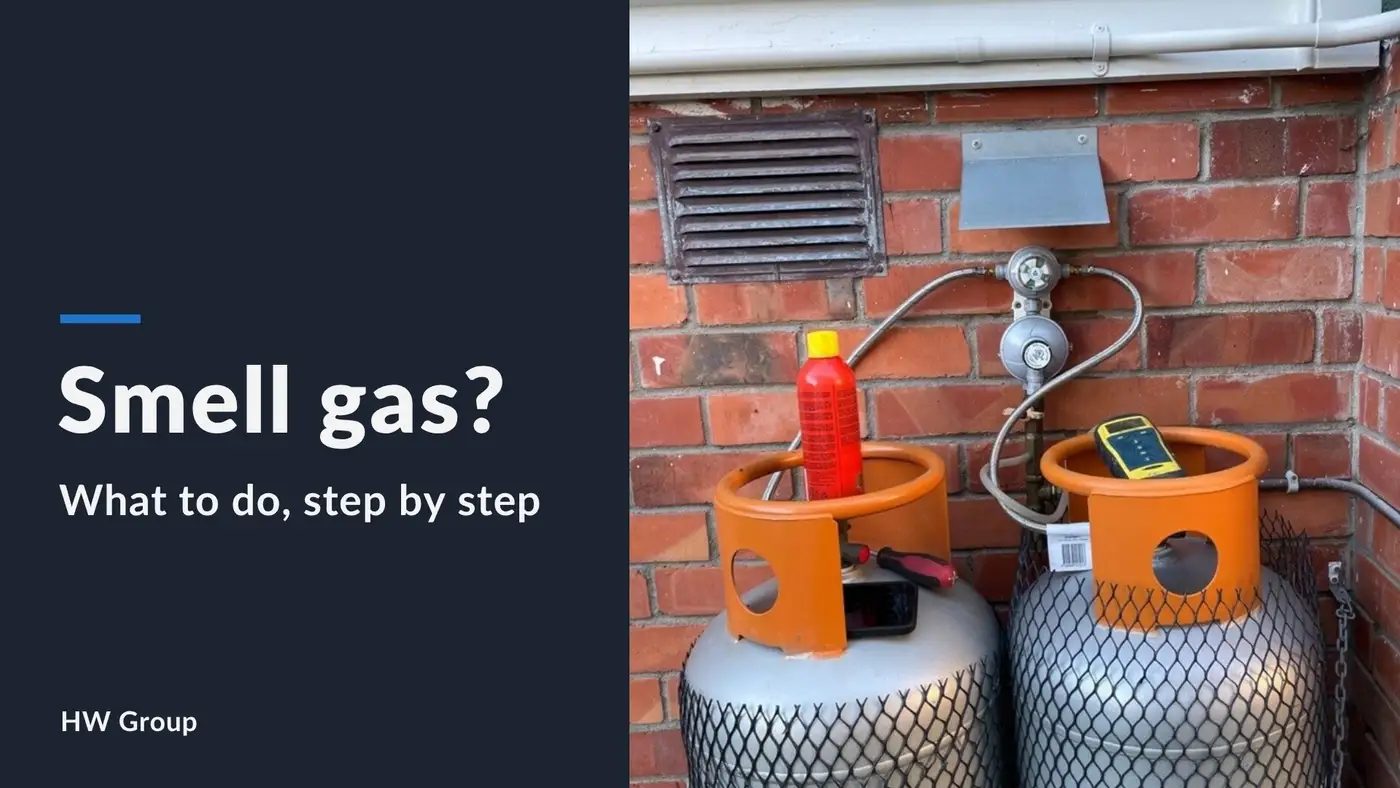
A gas smell in the house is worth taking seriously and handling calmly. Gas has no smell of its own: the suppliers add one so that even a small leak is noticed. The steps below are the ones New Zealand’s gas networks, LPG suppliers and WorkSafe publish.
They differ a little depending on whether your gas comes through a meter from the street or from LPG bottles outside, so this guide covers both, then explains who to call, who fixes the leak, and when the gas can go back on.
What should you do if you smell gas inside?
Get everyone out without making a spark, shutting off the gas and opening up as you go if you safely can, and make your calls from outside. The order below combines what Vector, Auckland’s natural gas network, Powerco, WorkSafe and the LPG suppliers publish.
- No flames. Don’t smoke, vape, or light a match, lighter or gas burner.
- Leave switches alone. Don’t turn lights or appliances on or off. WorkSafe explains that “a flick off or on could cause a spark and ignite the gas”.
- Don’t use a phone inside, including a mobile.
- Turn off any gas appliances, if you can do it safely.
- Turn the gas off at the meter or the bottles, if you know how and can do it safely. The next sections cover how.
- Open doors and windows as you go.
- Leave the house with everyone in it, and move well away.
- Call from outside. Call 111, then, for natural gas, Vector on 0800 764 764. On LPG, also call a gasfitter to check the installation.
WorkSafe’s list for a smell indoors starts with ventilating and says to go outside if the smell persists, while Vector and Powerco, the gas networks, say to leave the building straight away. If you’re on Auckland’s natural gas network, Vector’s instruction is the one to follow: get out and call from at least 20 metres away.
Natural gas or LPG: what’s different?
The steps above apply to both, but the gases behave differently, which matters for where a leak collects. Natural gas is lighter than air and disperses relatively easily. WorkSafe says LPG is heavier than air and collects in low points, which makes it harder to clear.
| Natural gas | LPG (bottles) | |
|---|---|---|
| Where it comes from | Vector’s network, through a meter outside the house | 45 kg bottles outside, or a 9 kg bottle on a barbecue or heater |
| Where to turn it off | The valve on the pipe at the meter | The valve on top of each bottle, all of them |
| How it behaves | Lighter than air; disperses relatively easily | Heavier than air; collects in low points and near drains |
| Who fixes the leak | A licensed gasfitter, for anything past the meter | A licensed gasfitter |
Rockgas advises keeping LPG away from openings and drains for that reason. A smell that’s strongest under the floor or around a drain fits with LPG settling.
How do you turn the gas off?
At the meter for natural gas: turn the handle on the valve until it sits across the pipe, horizontal and level with the ground. Some valves have no handle and need a spanner. For LPG, close the valve on top of each bottle by turning it clockwise. Only do either if you can reach it safely.
Natural gas. The valve is on the pipe beside the meter, outside the house. WorkSafe notes you may need a spanner. If reaching it means going back towards the smell, leave it.
LPG. WorkSafe says that where there’s more than one bottle, every valve needs to be closed, so on a twin-bottle changeover, close both. Many North Shore homes without natural gas run their califont on a pair of 45 kg bottles, so a twin-bottle setup is common here.
Turning the gas off doesn’t fix anything. It stops more gas reaching the leak while the people who can find it are on their way.
Who do you call?
Each call has its own job. 111 brings the fire service to deal with the immediate risk. On natural gas, Vector checks its network. A licensed gasfitter then finds and fixes any leak in your own pipework and appliances. On LPG there’s no network to call, so after 111 it’s a gasfitter, and your supplier for a leaking bottle.
- Vector runs the gas network. Its own advice is plain: “Our technicians are not gasfitters, so they are unable to fix any faults with your appliances or pipework.”
- A licensed gasfitter finds and repairs leaks in your pipework, fittings and appliances. GasNet, the Whanganui network, describes the usual pattern: where a leak is on the consumer’s pipework after the meter, the occupier is told to get a gasfitter to fix it before supply is restored.
- Your LPG supplier handles a leaking bottle. For a portable bottle, Rockgas advises turning off the valve, moving the bottle to a ventilated area, then contacting the supplier.
- Your gas retailer, the company that sends the bill, deals with supply problems such as a damaged meter cover or a meter that isn’t recording, as Vector and WorkSafe both say.
If you rent, tell your landlord or property manager what happened once everyone is safe.
What if the smell is outside?
Keep flames, cigarettes, vehicles and phones away, turn the gas off at the meter or bottle if it’s safe, and move away. Powerco adds two things: stay upwind, and close windows and doors so the gas doesn’t get into the house. Then call 111 and, for natural gas, Vector.
If a pipe has been hit while digging, Vector’s advice is to switch off machinery, move at least 20 metres away, and leave the damaged pipe venting: don’t try to block it, and don’t go back into the area. GasNet’s advice for an outdoor smell is the same in substance: don’t attempt to repair or stop the leak.
Is it gas, or something else?
Gas smells of rotten eggs or rotten cabbage, because of the odorant added to it, and a leak can show itself in other ways too. Drain smells can be mistaken for gas. If you can’t tell which it is, treat it as gas.
Rockgas lists the other clues for LPG. Use your ears for hissing, and your eyes for ice or frosting on the pipes and fittings, or a haze around the bottles. A higher bill with no change in use can point to a slow leak. Before assuming the worst, Rockgas also suggests checking whether a pilot light has gone out or a burner has been left on.
Drain and sewer smells. In December 2011, Police closed roads in central Whangārei over a suspected gas leak; the Fire Service found the odour came from sewer pipes. A drain smell is usually strongest at a plughole, a floor waste or the gully trap outside. Our guides to a smelly kitchen sink and a smelly gully trap cover those. Powerco’s view is that it’s better to report a smell that turns out not to be gas than to ignore one.
If you can’t smell it. Elgas notes that a small minority of people can’t smell the odorant at all. If that’s you or someone in the house, the other signs matter more.
Carbon monoxide is different. It has no smell and comes from a gas appliance that’s faulty, poorly ventilated or used in the wrong place, not from a leak. WorkSafe’s warning signs are a yellow flame instead of blue, soot on or around the appliance, and a smell like car exhaust. Low levels cause headaches, nausea, dizziness, tiredness and vomiting. If you suspect it, WorkSafe advises moving into fresh air and seeking medical attention, turning the appliance off if it’s safe, and having it checked before it’s used again.
Can you check for a leak yourself?
Not on the house’s gas pipes or fixed appliances. Powerco’s advice is not to try to find, stop or repair a leak, and the PGDB limits homeowners to portable appliances with the bottle attached, such as barbecues and patio heaters. On those, Rockgas describes a soapy water test for the bottle’s connections.
The test, for a 9 kg bottle on a barbecue:
- Mix a weak solution of soapy water.
- Connect the bottle, turn all the burner knobs off, then turn the bottle on.
- Brush or spray the solution on the connections between the bottle and the barbecue.
- If bubbles grow, the connection isn’t sealed. Turn the bottle off and tighten or fix it, then test again.
Never use a match or lighter to look for a leak. And if you can smell gas indoors, skip the testing and follow the steps at the top of this page.
When can the gas go back on?
Once a gasfitter has found and fixed the leak and is satisfied the installation is safe. WorkSafe says that whenever the supply has been interrupted, or appliances may have been left on, a gasfitter must be involved in turning the gas back on, because the pipes may have filled with air.
That means not relighting the califont, the fire or the hob yourself once the smell has gone. The gasfitter purges the air out of the pipework, relights appliances with pilot lights, and checks each one is running safely.
A repair is gasfitting work, so it finishes with a certificate once the gas is reconnected. Our guide to gas certificates explains what you should receive and what’s written on it.
What we do when you call us about a gas smell
Our hours are Monday to Friday, 7am to 5pm, and a smell of gas is a call to 111 first, then Vector on natural gas. We come in afterwards to find and fix the leak. At HW Group, gas work is done and certified by our own licensed gasfitter.
A leak test is a pressure test of the entire installation, not a sniff around the bottles. We test the whole system, find the leak, repair the pipework, fitting, regulator or appliance, and test again. Bottles, regulators and pigtails are replaced where they’ve failed, and unused gas points can be safely disconnected. The repair is certified, and the certificate reflects what we actually found. Every job is different; you get the price before we start.
Our gas leaks and certificates page covers the work in more detail.