
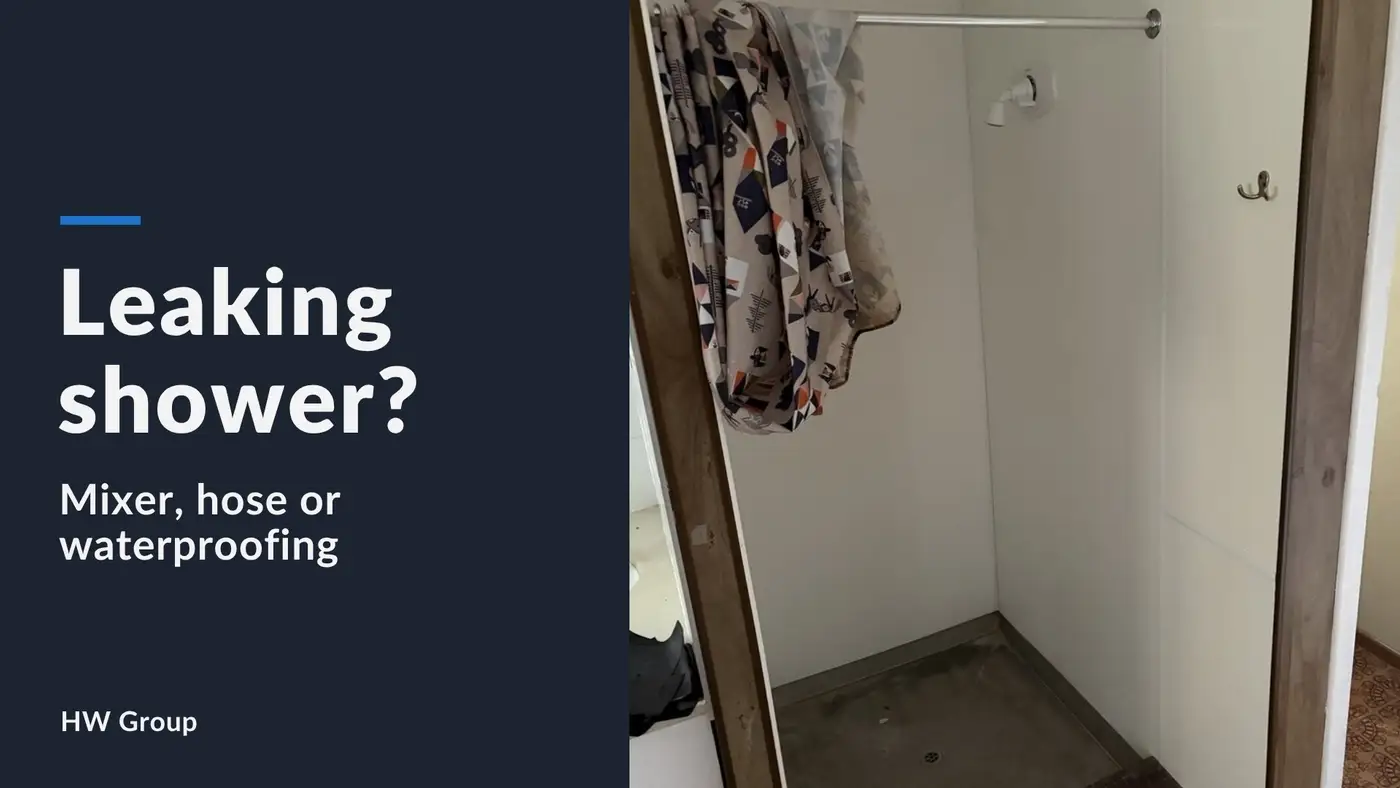
A leaking shower is two different problems. A drip from the head wastes water but stays in the shower. Water that gets behind the tiles or under the tray is the one to worry about.
This guide works through each part in turn: the mixer, the hose, the silicone and waterproofing, the tray and the waste. Then it gives a set of tests to run at home, and the signs that water is already getting into the house.
Where is your shower leaking from?
Start with where the water appears, and when: while the shower runs, after it’s turned off, or all the time. The table matches what you see to the usual cause and the first thing to check. Anything that shows outside the bathroom, in the next room or on the ceiling below, means water is getting behind the lining.
| What you see | Likely cause | First check |
|---|---|---|
| Head drips for a while after use, then stops | Water draining out of the head | Normal, especially with a rain head |
| Head drips steadily and never stops | Mixer cartridge or its seals | Does it stop when the water to the mixer is isolated? |
| Water around the handle or the front of the mixer | Loose front locking nut or a worn O-ring | Take the handle off and look |
| Drips where the hose joins the wall outlet or the handpiece | Hose washer or a split hose | Dry the joints, run it, watch |
| Puddle outside the door | Door seal, sweep or alignment | Run water at the door only |
| Water at the base of the walls, or mould along the tray edge | Failed silicone at the tray-to-wall joint | Look for gaps and lifting silicone |
| Damp skirting, bubbling paint or a musty wardrobe in the next room | Mixer body, pipes or the waterproofing behind the tiles | Tests below, then a plumber |
| Stain on the ceiling below an upstairs shower | Waste, tray or waterproofing | Run water into the waste only |
Why does the shower head drip after it’s turned off?
Some dripping is normal. Mira Showers, a shower manufacturer, says it is “perfectly normal” for a small amount of water to drip for a short time after use, and that rain and overhead heads can release trapped water for minutes or hours. A drip that never stops, day or night, is the mixer’s cartridge or its seals.
Most single-lever shower mixers shut the water off with a ceramic disc cartridge. Manufacturers’ troubleshooting pages give the same main cause of a drip: grit or scale between the discs, or a torn or nicked O-ring, stopping the cartridge from sealing. Sometimes cleaning it fixes the drip. More often it gets replaced, and the new one has to match the mixer’s brand and model, because cartridges aren’t universal. Our article on why a tap keeps dripping covers how washers, cartridges and mixers each fail.
If you replace a cartridge yourself, two cautions. A handle stuck with scale tempts you to lever it off, and leaning a tool on the wall can crack a tile. And if a new cartridge still drips, it usually isn’t seated properly or isn’t the right one.
Is the mixer leaking into the wall?
Take the handle off and look. Water coming from the front of the mixer, around the spindle, often means the front locking nut has worked loose or an O-ring has failed. Water from anywhere else along the mixer body, or running out from behind the faceplate, means the leak is inside the wall cavity and needs a plumber.
The faceplate is a useful clue. BRANZ, the building research body, advises sealing the sides and top of a shower fitting’s faceplate but not the bottom. That way, water leaking behind the plate runs out where you can see it, instead of staying in the wall. If water appears under the plate, don’t run silicone along the bottom to stop it: that only hides the leak.
Leaks at the mixer body or its pipe joints are usually slow, so they tend to show as damage elsewhere long before anyone sees a drip. BRANZ lists incorrect installation of shower mixers among the common causes of leaks in tiled showers.
In a North Shore house built or replumbed between the late 1970s and the late 1980s, the pipes behind the shower wall might be Dux Quest, which tends to fail at the fittings with age. Our guide to checking for Dux Quest pipes shows how to tell in five minutes.
Could it be the hand-shower hose?
Yes, and it’s often mistaken for a mixer leak. A hand-shower hose has a small rubber washer at each end, and the handpiece has its own seal. A drip at either end of the hose is usually a hardened or cracked washer. Water seeping from along the hose means it has split inside and needs replacing.
Dry both joints with a towel, run the shower, and watch. If the drip forms at the connection to the wall outlet or the handpiece, a new washer is the fix, done up firmly but not overtightened, which damages it. A split near the handpiece can look like a leak from the head, so check the hose before you blame the mixer.
Is it the silicone, the grout or the waterproofing?
Tiles and grout aren’t the waterproofing. BRANZ is clear that cement-based grout isn’t waterproof, which is why a tiled shower needs a waterproof membrane behind and under the tiles. Silicone seals the joints. If water gets past the silicone and the membrane has failed, it goes into the wall or floor.
BRANZ says leaks in tiled showers are most often traced to junctions: floor to wall, hob to wall, and around the drain. Those are the same places the silicone does its work, so start there. Look for silicone that has lifted, split, shrunk or gone black, and grout that’s cracked or missing.
Resealing is a reasonable job to do yourself. Remove the old silicone, clean and dry the joint completely, run a fresh bead of wet area silicone and tool it into the gap. Bunnings’ guide uses an icy pole stick to push the silicone in and sugar soap for the finish. Then leave it alone: Selleys says its Wet Area Silicone can take water a day after application.
If the silicone and grout look sound but the leak keeps coming back, the membrane behind the tiles is the likely cause. That can’t be fixed from the surface. It means taking the tiles off, repairing or replacing the waterproofing, and retiling.
What about the tray, the waste or the door?
An acrylic or moulded tray can crack, usually where it wasn’t fully supported underneath, and the crack lets water into the floor. The waste can leak where it seals to the tray or below it, which shows as a stain on the ceiling under an upstairs shower. Water outside the door is often just a worn seal.
Door seals and the sweep along the bottom harden and shrink with age, and a door that has dropped a few millimetres out of line lets water past the threshold. Those are simple parts and quick to check before you suspect anything worse.
The waste is a different matter. The Plumbers, Gasfitters and Drainlayers Board names traps and waste pipes among the things a homeowner may not fix or unfix.
How do you narrow it down at home?
Test one part at a time, with everything dry to start and a towel laid outside the shower. Run water only where you’re testing and check for damp after each step. If the leak appears, you’ve found the part. If it only shows in the next room or on the ceiling below, check there.
- Mixer off, nothing running. Check under the faceplate and along the hose joints. Anything wet now, with no water used, is the mixer or the supply side.
- Waste and tray only. Run the hand shower gently straight down into the waste, or pour in a few buckets of water, keeping water off the walls and door.
- Walls and corners. Spray each wall and each corner junction in turn, then the joint where the tray meets the wall.
- Door and screen. Spray along the door seals, the bottom sweep and the screen’s edges.
- The meter. If you can’t find it and you suspect a hidden supply leak, do a meter test: no water used for four hours or more, as Watercare describes in our guide to finding a leak and who pays. A toilet that keeps topping itself up spoils the test, so rule out a toilet running into the bowl first.
While you’re there, tap the tiles around the shower lightly with the handle of a screwdriver. A hollow sound can mean the adhesive behind has let go, often because water has got in.
What are the signs of hidden water damage?
Water behind a shower usually shows up somewhere else first. BRANZ notes that leaks from tiled showers can damage linings and framing without being noticed for some time, and the first sign is often not in the bathroom but in the wardrobe of the bedroom next door.
Signs to look for on the other side of the shower wall, and below it:
- a musty smell in a cupboard, wardrobe or corner that cleaning doesn’t shift
- swollen or stained skirting boards, or a floor that stays damp
- paint peeling or plaster bubbling on the wall behind the shower
- a stain on the ceiling below an upstairs bathroom
- loose or hollow-sounding tiles, and grout that keeps cracking in the same spot
Stop using the shower if you see any of these, and get it checked.
There’s an insurance angle too. Tower, for example, says gradual damage is a policy exclusion, and that its hidden gradual water damage benefit doesn’t apply to a leak in a shower base, recess or cubicle. Other insurers word it differently, so check your own policy with your insurer.
What we do when you call us about a leaking shower
We check the likely cause first rather than pulling the wall apart: the mixer, the hose and fittings, the waste and the tray, then the walls. A leak behind the wall or under the tray comes before anything cosmetic. You get the options and the price before work starts.
A worn cartridge or a failed seal is a repair. We also fix tray, waste and liner leaks, replace mixers and shower heads, and replace shower doors and glass. Anything behind the wall is tested before it’s closed up. If the leak is hidden, we narrow it down with the meter and by isolating sections before we cut anything, so any opening is small, and where an insurance claim is involved, we can advise your insurer on what we found.
If the tray is cracked, the liner is leaking or the mixer has already been repaired twice, we talk to you about replacing the shower. Where the waterproofing behind the tiles has failed, the fix is a strip-out and retile, which is a bathroom renovation conversation. Our shower repairs page covers the work in more detail.