
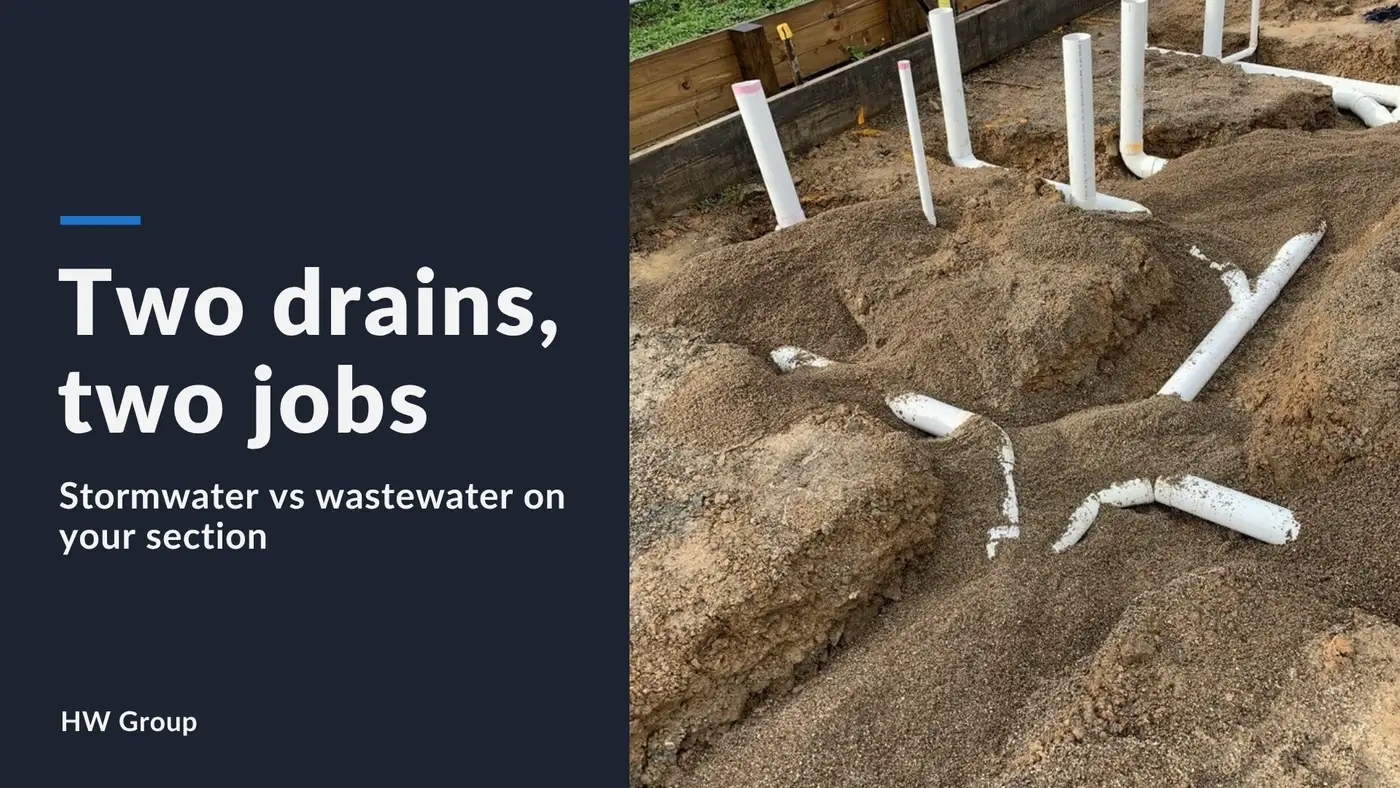
Most Auckland sections have two drainage systems underground, built for different jobs and run by different organisations. One takes rain off the roof and paving. The other takes everything that goes down a toilet, sink, shower or washing machine.
At ground level they can look alike: a grate here, a pipe there. This guide covers how to tell them apart, who looks after each, and why connecting one to the other causes trouble for you, your neighbours and the nearest beach.
What’s the difference between stormwater and wastewater?
Stormwater is rain that runs off roofs, paving and roads. It isn’t treated: it flows through the stormwater network to streams and the sea. Wastewater, also called sewage, is the used water from toilets, sinks, showers, baths and washing machines. It travels through Watercare’s network to a treatment plant.
Watercare’s own explainer puts stormwater’s job simply: in heavy rain, water that the ground can’t absorb “needs to be collected so it doesn’t cause flooding”. Wastewater is mostly water too; the rest is human waste, food scraps, cooking fats, oil and grease, and debris such as sand, grit and plastic.
In most of Auckland the two networks are separate. Watercare says some older parts of central Auckland still have a combined network, where both share the same pipes and are designed to overflow at set points in heavy rain. Everywhere else, they’re meant to stay apart from the first grate to the last pipe.
Who looks after each one?
Watercare is responsible for wastewater and Auckland Council for stormwater, Watercare says. You pay for them separately too: Watercare through your monthly bill, and the council through your rates. On your own section, the private pipes of both systems are the owner’s to maintain, up to where they join the public network.
Wastewater. Watercare’s dividing line is the point of supply. If the public sewer runs through your property, it’s the joint where your pipe meets it. If the sewer runs outside your boundary, it’s where your pipe leaves the property. Watercare looks after everything beyond that, including manholes on private land. Our guide to tree roots in drains covers this boundary in more detail.
Stormwater. Auckland Council lists the private stormwater assets an owner maintains, including spouting, roof gutters, downpipes, grates, catchpits, pipes, rain tanks and soakage pits. Its boundary is where your private pipes connect to the public network, or where the connection crosses into a neighbour’s property or a reserve. The council’s Healthy Waters department runs the public side: about 7,000 km of pipes and 120,000 catchpits and roadside drains.
Public pipes of either kind can cross private land. Auckland Council’s GeoMaps viewer shows them, and its colour key is worth knowing: generally, stormwater is green, wastewater is red, and water supply is blue.
How do you tell which drain is which on your section?
By what feeds it. Anything that takes water from inside the house, starting with the gully trap, is wastewater. Anything that takes rain off the roof or the ground is stormwater. A manhole can belong to either network, and GeoMaps shows which.
| What you see | What it does | Which system |
|---|---|---|
| Gully trap: a small raised grate by the kitchen, bathroom or laundry wall, with pipes from inside discharging into it | Collects wastewater from inside and passes it to the sewer | Wastewater |
| Downpipe | Carries roof water from the spouting down to an underground pipe | Stormwater |
| Yard sump or catchpit: a grated pit in a lawn, yard or driveway | Collects surface water from the ground around it | Stormwater |
| Channel drain: a long, narrow grate across a driveway, garage door or patio | Catches water running off paving | Stormwater |
| Soakage pit | Lets stormwater soak into the ground instead of entering a pipe | Stormwater |
| Rain tank | Stores roof water for reuse | Stormwater |
| Manhole cover | Gives access to a public pipe below | Either: Watercare’s if wastewater, the council’s if stormwater |
If a grate has food scraps, grey water or toilet paper in it, it’s carrying wastewater, whatever it looks like. Our gully trap guide covers how a gully trap should be set up and what its overflows and smells mean.
Why do cross-connections matter?
Because each network is built for its own load. Rain piped into the wastewater system overloads it and pushes sewage out of gully traps and manholes. Wastewater getting into the stormwater system flows untreated to streams and beaches. Watercare and Auckland Council both inspect private drains to find these connections.
Stormwater into wastewater. Watercare says that in wet weather the stormwater from an average roof equals the wastewater flow from more than 40 households. The ways it gets in are the ones Watercare and the council check for:
- a downpipe running into a gully trap or a wastewater pipe
- a gully trap set too low, or without a grate, so surface and flood water runs into it
- old, cracked wastewater pipes that let stormwater seep in
Watercare’s bylaw is direct about it: “No person may cause or allow stormwater to enter the wastewater network or any private drain which is connected to the wastewater network.”
Wastewater into stormwater. Auckland Council’s Safe Networks programme, run with Watercare, traces faecal contamination at Safeswim sites. It names “cross connections between the stormwater and wastewater networks” and “damaged public and private drainage” as causes. Among other things, its inspectors check that a property’s wastewater pipes are connected to the public wastewater network.
Inspections. Watercare inspects private drainage across Auckland with harmless smoke, non-toxic dye and cameras, and notifies you by mail before it visits. Safe Networks contacts residents before an inspection too. If anything on your section needs changing, reconnecting a downpipe to the stormwater drain or raising a gully trap is work for a licensed drainlayer.
What can go down a stormwater drain?
Rain, and nothing else. Auckland Council’s message is that what gets into stormwater drains ends up at sea. It asks you to keep chemicals, paint, oil, lawn clippings, rubbish and building waste out, to send pool and spa water down the wastewater drains instead, and to wash the car on the lawn rather than the drive.
Renovations are worth watching. The council’s Stormwater Bylaw lists sediment, concrete, cement slurry, soap and detergents among the contaminants that can affect the stormwater network, so washing out a concrete mixer or a paint tray over a yard sump sends them towards the sea.
Some things don’t belong in either system. Watercare asks that paint, pesticides, solvents and motor oil stay out of the laundry tub as well.
Who fixes a blocked stormwater drain?
On your section, the owner. Auckland Council’s Stormwater Bylaw says a private stormwater system must be kept “in good operating condition” and must not cause a nuisance, and the council’s advice is that your first call for a drainage problem is a plumber or drainage contractor. Blocked public drains, roadside catchpits and street flooding go to the council on 09 301 0101.
Water pooling on the lawn or against the house after rain, a sump that overflows, or a downpipe that backs up are the signs to watch for. The council’s advice for keeping the system working:
- Keep pipes and surface drains clear of litter, leaves and sticks, and keep spouting clear so leaves don’t wash down the downpipes.
- Shape the ground so water drains away from buildings to a drain at the lowest point.
- Think about next door: concreting a driveway or patio can push more water onto a neighbour’s property.
Clearing leaves and silt from a sump or channel drain is a job you can do yourself. The Plumbers, Gasfitters and Drainlayers Board lets you clear a blocked drain, but repairs and alterations to any drain, stormwater included, are restricted to licensed drainlayers.
If you rent the property out, the Healthy Homes standards cover drainage, and Tenancy Services sets out what they ask of landlords. Our guide to blocked drains in a rental covers how repairs get reported and arranged.
For a blocked wastewater drain or an overflowing gully trap, it’s Watercare first, on (09) 442 2222, option 1. Not sure whether the water you’re seeing is stormwater, groundwater or a leak? Our guide to water leaks on your property shows how to tell.
What we do when you call us about stormwater or wastewater drains
We repair and install both. On the stormwater side, that’s stormwater lines, sumps and downpipe connections, and channel and strip drains for driveways, patios and garages. On the wastewater side, it’s cracked, collapsed and misaligned lines, and gully traps that are broken, too low or below ground level. For new builds, extensions, sleepouts and minor dwellings, we lay both systems.
We locate the fault first and open only what needs opening, and if the fault is on the public side, we tell you who to call. All drainlaying is done by our licensed drainlayer. Where the work needs consent, we handle the application and the inspection and hand over the as-built record at the end. You get the price before we start.
Our drainage repairs page covers the work in more detail. Spouting and downpipes themselves are on our gutters, spouting and downpipes page.