
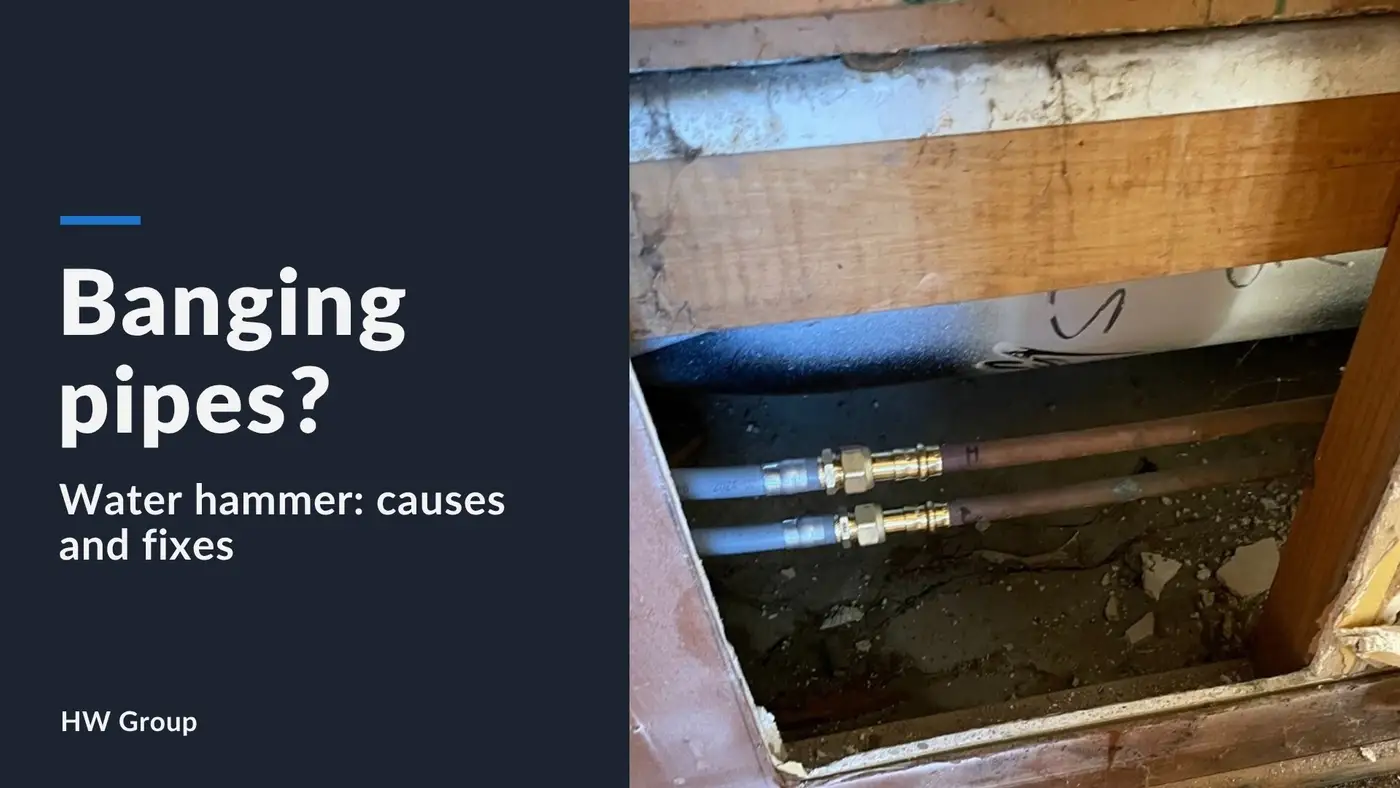
A bang, thud or shudder in the walls is usually water hammer, and it nearly always has a simple trigger: a tap, an appliance or a valve that shuts the water off too fast. The useful question is when it happens. That tells you which valve is responsible and which of three or four fixes applies.
This guide covers what water hammer is, how to tell it from the other noises pipes make, what you can check yourself, and what a plumber does about it.
What is water hammer?
A pressure shock in the pipes. BRANZ describes it as a surge that “generally occurs in a high pressure system when the flow of water is suddenly stopped”. The moving water has nowhere to go, so a shockwave runs back along the pipe and makes it vibrate. It’s loudest in metal pipe, but plastic pipe can do it too.
Speed is what drives it. BRANZ notes that it is “related directly to the water velocity”: the faster the water is moving when it stops, the bigger the shock. That’s why the same tap can be silent in one house and bang in another, and why it often starts after something in the house changes: new tapware, a new appliance, or higher pressure.
What kind of noise is it?
Water hammer is a single bang or a short rattle at the moment water stops. Other pipe noises happen while water runs, while it heats, or with nothing running at all, and they have different causes. Note when your noise happens and where it seems to come from, then find it in the table.
| When it happens | Likely cause | Check first |
|---|---|---|
| A bang as a lever mixer is shut | Water hammer from a fast-closing tap | Close the tap slowly; if the bang goes, that’s the trigger |
| A thud as the washing machine or dishwasher stops filling | Water hammer from the appliance’s valve | Whether it happens at the same point every cycle |
| A bang at several taps, worse since new tapware or a pressure upgrade | Pressure too high for the pipework | Whether the house has a pressure limiting valve on the supply |
| A knock or rattle along a wall as water runs or stops | A pipe moving against the framing | Whether you can see the pipe under the floor or in the roof |
| A judder or groan while the toilet cistern refills | The cistern’s inlet valve, or too much flow into it | Whether it stops when the cistern’s isolating valve is turned partly down |
| Ticking or creaking after hot water runs | Hot pipe expanding against a tight clip or the framing | Whether it only happens on the hot side |
| Rumbling or hissing at the cylinder while it heats | Scale or sediment in the cylinder | The cylinder’s age |
| Knocking with nothing running | Something is using water, or the cylinder is heating | The water meter, with every tap off |
A cylinder that rumbles as it heats is a cylinder question; our guide to how long hot water cylinders last covers what it means. A toilet that refills by itself every so often is losing water into the bowl, which our guide to a toilet running into the bowl explains.
Why is it happening in your house?
Three things combine: a valve that closes fast, water moving quickly, and pressure behind it. BRANZ lists lever taps with ceramic discs, appliance solenoid valves, spring-closing valves and pumps as the usual triggers. High pressure makes every one of them worse, and loose pipes turn a small shock into a loud bang.
Fast valves. A washing machine’s solenoid valve can close in as little as 30 milliseconds, far faster than a hand on a tap. A lever mixer snapped shut is fast too, where an older screw-down tap closes over several turns.
Pressure. Watercare normally supplies at least 200 kPa, but BRANZ notes that mains pressure can reach 900 kPa or more in a few places, and a house low on a slope gets more than one at the top. Without a pressure limiting valve on the supply, every tap in the house sees all of it.
A recent pressure upgrade. Changing from a low pressure to a mains pressure cylinder puts the hot pipes and every hot tap under mains pressure for the first time. Our guide to mains pressure vs low pressure cylinders covers the other changes that upgrade brings.
Can water hammer damage your pipes?
Over time, yes. One bang is a nuisance, but BRANZ says pressure that’s too high causes “high wear and tear on the system”, and each shock loads the same joints and valves again. Older joints and fittings feel it first, so persistent banging in an older house is worth fixing rather than living with.
The parts most exposed are the joints near the valve that causes the shock and the valves inside the appliance itself. In homes built or replumbed between the late 1970s and the late 1980s, Dux Quest plastic pipe fails at its fittings with age, and repeated shocks don’t help; our Dux Quest guide shows how to check for it. Copper joints can also let go after decades of pressure.
Signs that it’s gone past noise: a damp patch on a wall or ceiling near where the banging comes from, a fitting under a sink that’s started to weep, or a water meter that moves with every tap off.
What can you check yourself?
Work out which valve causes it: run each tap and appliance in turn and note which one bangs. Then check the pressure side. Watercare’s advice for high pressure is to turn your water meter tap down gently, clockwise, and talk to a plumber about a pressure-reducing valve. Anything that means fixing or unfixing a pipe is a plumber’s job.
- The tap test. Close the suspect lever mixer slowly. If the bang disappears, the mixer is the trigger, and either a gentler hand or a fix at that outlet will stop it.
- The appliance test. Run the washing machine or dishwasher on its own and listen at the start and end of each fill.
- The meter tap. It’s in the meter box at your boundary. Turning it down gently lowers the pressure into the house. It’s a stopgap, not a fix, and turning it down too far starves the house; our guide to low water pressure explains Watercare’s minimum.
- The cistern. If the toilet judders as it refills, turn the small isolating valve to the cistern partly down. Grit or a worn washer in the inlet valve also causes it.
Know where the line sits. The Plumbers, Gasfitters and Drainlayers Board lets a homeowner install a dishwasher or washing machine and replace or repair taps and ball cocks (the float valve in a cistern), but not fix or unfix any pipe that supplies water.
Some online advice says to drain the whole house to recharge its air chambers. That only applies to homes with air chambers, capped vertical pipes built in to cushion the shock, and does nothing for a modern sealed arrestor.
Do you need a pressure limiting valve?
If the banging happens at several outlets, yes, it’s the first thing to check. BRANZ recommends asking a licensed plumber to fit a 350 kPa pressure limiting valve on the supply where too-high pressure is suspected, after checking it suits your fixtures and appliances. One valve at the point of entry protects every pipe in the house.
A mains pressure cylinder has its own limiting valve; Rinnai specifies 500 kPa or less on its cylinders. That valve sits on the cylinder’s cold inlet and controls what goes into the cylinder. The cold pipes to your taps are upstream of it, so without a valve on the supply they still run at full street pressure.
A house that was quiet for years and starts banging at every tap is worth having its supply pressure measured.
What is a water hammer arrestor, and where does it go?
A small cylinder on the supply pipe that absorbs the shock. BRANZ describes arrestors as using “a piston and air pressure to absorb the surge in pressure”, and advises having a licensed plumber fit one on the pipe just upstream of the device causing the problem, such as a dishwasher or washing machine. It treats one outlet, not the house.
Modern arrestors have a sealed, pre-charged air chamber, so they don’t waterlog the way the old capped pipes did. For a washing machine, they’re made to fit between the machine’s taps and its hoses, one on the hot and one on the cold. For a dishwasher or a particular mixer, the arrestor goes on the supply to that outlet, as close to the valve as it can sit.
An arrestor isn’t a fix for high pressure. One maker’s installation sheet requires a pressure reducing valve upstream of the arrestor wherever the pressure exceeds about 414 kPa. Where the pressure is high, the limiting valve comes first and the arrestor second.
How are loose pipes fixed?
By clipping them so they can’t strike anything, while still letting hot pipes expand. BRANZ’s list: keep pipes off the structure, use rubber-insulated clips or clip over the pipe insulation, fix runs rigidly, add relief bends or flexible sections, and fit grommets or cushioned packers where pipes pass through framing.
Under a suspended timber floor or in the roof space, most pipe runs can be reached and re-clipped without opening a wall. Hot pipes need room to move, since BRANZ’s guidance is that pipework must allow for thermal movement, so a clip that grips too tightly can swap a bang for a tick.
Pipes inside a finished wall are the hard case. If the noise is clearly in one wall and nothing else has fixed it, the choice is between treating the cause upstream (pressure, or an arrestor at the valve) and opening the lining. BRANZ makes the point that preventing water hammer is easier than fixing it after a building is finished, which is why renovations are the time to get the clips right.
What we do when you call us about banging pipes
We find the cause, not just the symptom. That starts with the supply: we check the pressure, and if it’s high and unregulated, we tell you and fit a pressure reducing valve where one is needed. Then we find the valve that triggers the bang and the pipe that carries it.
If the fix sits at a tap, an appliance or a run of pipe rather than the supply, you hear what it is and the price before we start. Where old galvanised or Dux Quest pipework has taken years of pressure, we tell you that straight, so you can plan rather than wait for a leak.
Our water mains and pressure page covers pressure valves, mains repairs and upgrades in more detail.